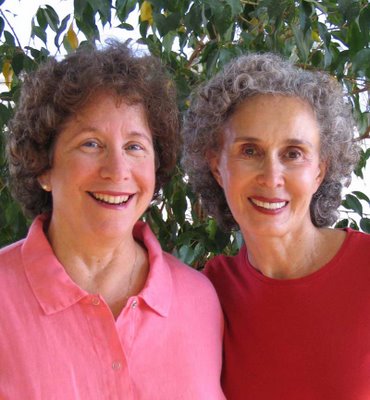
Anne Kreamer, author of "Going Gray," is our guest on this Virtual Book Tour. Welcome, Anne! We know that this interview will get a lot of you thinking first thing this morning, so let's get started:
What made you decide to stop coloring your hair?A friend sent me photographs from a trip we’d recently taken and in one of them I was standing with my sixteen-year old naturally blonde daughter and a good friend with gray hair. I was in the middle with a harsh and dark brown hair dye and when I looked at that photograph I realized that I didn’t like the way I looked. I saw that my face and hair no longer really jibed with each other.
How did you decide to go about letting your hair grow in?That was the hardest part of the whole process. I was fond of my shoulder length hair and didn’t want to get a buzz cut and start fresh, so I went to my colorist assuming that we could just start to pull the color out. But unfortunately it isn’t simple so simple. If you don’t want to cut your hair short, the best route is to add different kinds of highlights to blend in with your roots as they grow out as well as a toner that can help to blend in the various colors
How long did it take?From start to finish it took me about 18 months to get rid of all of my color. And some days it was a challenge – about mid-point I felt like I looked like an old crazy kind of bag lady. My hair was brittle and sort of unkempt looking and I finally decided to cut about four inches off. It was wonderfully liberating. It felt as if I’d cut off my old and disingenuous dyed past and was ready to look to the future with a clear eye about my age.
What made you decide to write a book about the experience?My usual way of making any kind of big change in life is to tell as many people as I can what I’m intending to do, and then I have to follow through. So I suggested that I write a piece for More magazine about the experience. And when More got the most letters from their readers about my piece they’d ever had I thought I’d touched a nerve that was worth analyzing in greater detail.
What were the issues that you’d uncovered while your hair was growing out?I discovered that I was worried about whether I could ever be attractive to men in the same way with gray hair as I thought I had been with my dyed brown hair. And when I began to talk with other women about my experience I uncovered that worry about their loss of attractiveness is perhaps the single greatest fear almost all women feel as they get older since gray hair is our most visible signal of age. Women were also terrified that they would lose professional opportunity if they were perceived as old.
How did you go about getting at the underlying truth or issues behind those fears?I did several different things.
I talked to as many different kinds of men and women as I could – from well-known people like Emmylou Harris, Anna Quindlen, Frances McDormand, Mireille Guiliano (French Women Don’t Get Fat), Nora Ephron and Governor Ann Richards to regular people I met across the country. I conducted a national survey of 500 people probing all sorts of issues around aging and the things that we do to mask the signs of aging. I used myself as a guinea pig in a variety of situations – I pseudo-dated on-line, went out to bars, interviewed headhunters and met in cognito with image consultants. And I read everything I could get my hands on.
What surprised you the most?You mean after I figured out that I had spent $65,000 on hair color alone during the 25 years I dyed my hair? (That $65,000 would today be worth $300,000 after adjusting for inflation!)
Wow! But yes, beyond that statistic.What most surprised me was discovering that when it comes to letting their hair be its natural gray, or not, I think a lot of women tend to be worried about the wrong thing. I certainly was. More women are more worried that men won’t find them attractive with gray hair, and yet believe that gray hair is acceptable professionally. My research revealed that the truth is the opposite.
What do you mean?Well, for instance, I tried to really get at whether gray hair was unattractive to men on Match.com. I figured if I was honest about my age and interests and posted an image of myself with gray hair that I’d naturally get fewer “dates” (or “winks” as overtures are called on Match.com) than I would when I posted the same information but instead used an image of myself with my hair Photo-shopped brown. And shockingly, after I did the experiment three times in three different cities, three times as many men in New York, Chicago and L.A. were interested in going out with me when my hair was gray. This blew my mind. When I was on Good Morning America, they replicated the experiment with a 61-year-old widow in Florida and she had the exact same results! Maybe men figured that if we were being honest about the color of our hair that perhaps our lack of pretence would make us more accessible and easier to date. Or maybe the gray made me stand out from the overwhelming majority of Match-com women my age who color their hair. I honestly don’t know. But I do know the results were inspiring. We should give men a lot more credit.
Did you test this theory in the real world?
Yes, as a matter of fact, I did. I went out to a variety of New York bars (from places where Wall Street guys would hang out to the kinds where locals went to watch sports) and once again I was really surprised by how it seemed that my gray hair color did nothing to prevent me from meeting and talking with nice-looking younger guys. Most women I talked with during research for my book were convinced that if a woman had gray hair and then got divorced that it was absolutely essential that she dye her hair if she were ever going to date again. I strongly believe that that is not the case. And moreover, I would suggest to most women that if the guy they’re interested in will only like them if they dye their hair, then maybe he’s not Mr. Right.
Was there anything else that supports your contrarian point of view?The results from my survey were compelling. There is a huge double standard. Through a Photo shopped experiment I also tested precisely how much gray hair aged a person and what I discovered is that if a person is in their 40s or 50s, gray hair allows others to accurately guess a person’s age. When I Photo shopped the gray hair out with brown, the person was guessed to be about two or three years younger. Which seems like a modest difference to work so hard to achieve. I think the reality is we are only fooling ourselves about our age through the use of hair color.
So what was the story professionally?I interviewed different media headhunters – one in New York, the other based in Colorado and both said that they had neither a female client nor a prospective job candidate with gray hair. They went into real detail about how gray hair was consistently viewed as a signal that a person would not be “right” for most company cultures. And they suggested that if a woman were in sales or marketing allowing herself to go gray on the job would be the kiss of death.
You didn’t expect this?I met with these women assuming they’d tell me that if I wanted to get back into the corporate arena then I’d have to update my image and dye my hair. But I didn’t expect them to be so emphatic about how damaging gray hair could be to a woman’s career. What I’ve come to believe is that we need women in prominent positions (say, Hillary Clinton) to have their natural hair color in order to give other women the choice or option to dye or not to dye. In my mind it’s like baldness was for men before professional athletes like Michael Jordan or actors like Bruce Willis made baldness seem sexy and masculine. If there were more Emmylou Harris’ the choice would be easier.
What about the image consultants?I was completely taken aback by the image consultants. I met with three very different people and firms and in each instance they believed that my gray hair could be a professional asset – something along the lines of the way Meryl Streep looked playing the character, Miranda Priestly in the Devil Wears Prada. The main thing I learned from the consultants is that if you change any one aspect of your look, then it is important to modify everything else to bring out your best features. I needed to update my style and color palette.
What about men?I interviewed a lot of men for the book and with the exception of a writer living in Hollywood, all of the men claimed to be indifferent to the color of a woman’s hair. If a woman is lively and interested in what they are saying and seems to take care in her personal appearance, then hair color was irrelevant to the men – and they are so worried about going bald that the color of our hair never entered the equation!
And I’ve been thrilled by the number of men who have written to me since the book was published telling me that they’d bought it for their wives, or mothers or sisters. They hoped that by reading the book the women would come to understand that men like women just the way they are.
Unfortunately, I also discovered that men are the next market segment that the cosmetic companies are targeting for hair color. The female market is practically saturated so men are the only growth area left. It’s a scary thought.
And did you find any differences with people from other countries?I interviewed Mireille Guiliano, the author of the French Women Don’t Get Fat books, and also several other European men and women and, not surprisingly, found that Europeans in general have a greater tolerance for a wide range of what women can look like as they age.
Where did you end up? Do you disapprove of people who dye their hair?I certainly don’t disapprove of people who dye their hair – after all, I’m a very recent convert to my natural color. And I no longer work in a corporate environment so I have the luxury of feeling safe and comfortable writing at home by myself with my gray hair and I’ve been married to the same man for 30 years. But I did come through on the other side happier and more at home in my body than when I dyed my hair. It feels liberating to walk down the street and know that as much as possible I’m projecting pretty much who I am to the world. I love not spending the time at the beauty shop and I really love not spending the money.
I feel like I’m a better role model for my daughters and it seems like my husband finds me as sexy with my natural hair.
I also discovered through my research and reading that acknowledgement of your real age is one of the most important tools we have to increase the odds that we’ll age healthfully and happily. Several studies have clearly indicated that people who accept their age actually live longer. So I love that by choosing to give up one little piece of artifice I might actually be helping myself stick around longer for the grandchildren I long to know.
Thanks for taking the time today to inform our readers, Anne. I went gray a couple of years ago and I had lots of ambivalence before I took the plunge. So, Sandwiched Boomers, I know you have some questions and concerns. Anne will be checking in throughout the day - so here's your chance - just click on "comments" and fire away.Labels: "Going Gray", age healthfully, Anna Quindlen, Anne Kreamer, Good Morning America, image consultants, Match.com, national survey, reaction from men, role model, Sandwiched Boomers
 Everything in all the parenting books is finished for me now. Penelope Leach, T. Berry Brazelton, Dr. Spock. The ones on sibling rivalry and sleeping through the night and early-childhood education have all grown obsolete. Along with Goodnight Moon, and Where the Wild Things Are, they are battered, spotted, well used. But I suspect that if you flipped the pages, dust would rise like memories. What those books taught me, and finally what the women on the playground, and the well-meaning relations - well what they taught me was that they couldn't really teach me very much at all.