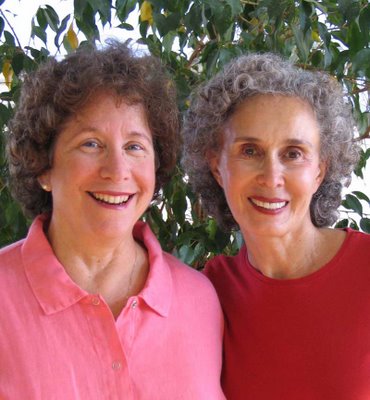
We are happy to welcome
Dr. Susan Lieberman back for more questions and answers about her book. In
The Mother-In-Law’s Manual: Proven Strategies for Creating and Maintaining Healthy Relationships with Married Children, Susan uses the same strategy she found so helpful when her children were growing up - talking to other women going through the same experiences. She deals with all facets of the in-law relationship, including how to handle difficult family members, how to discuss what seems like impending disaster and how to approach our babies having babies.
We've posed some questions you might want to ask her if you came to one of her book signings. And feel free to send us in your own through the comment link below.
Nourishing Relationships: Some mothers-in-law have confided, "My child’s spouse shuts me out. How do I handle this?"
Susan: I wish we could stand on the balcony together and watch what is happening…whether there is something you are unintentionally doing that pushes a button, whether his or her behavior doesn’t seem so cold to others or whether, in fact, you are, indeed, getting the cold shoulder.
There isn’t one best response. In many cases, you might find some quiet moments with your own child and ask for advice – which is different than criticizing the partner. "You know, I don’t seem to be getting it just right with X, and I so want us to have an easy relationship. Could you give me some advice about how to do this better?"
Now, if you get the advice, all you can do is LISTEN. You can't get defensive, counter, or argue. Breathe, breathe, breathe.
Maybe you can talk directly to your in-law, but you have to have enough comfort to feel centered and relaxed to this. If you are angry, hurt or in any other way off balance, these conversations are more difficult. The best approach is to ask questions, ask advice, not make statements.
It is possible that others in the family can offer advice – but then you have to take it…have to consider what you are being told and try out the suggestions and see how they work.
And, in some cases, we may have to make do with a relationship that is less than we wish. Here is what I discovered for myself. When I have judgments about my daughters-in-law, they pick up the vibrations. What I have to change is my own attitude, not theirs. I have to be the person I want them to be, treating others with the same respect and affection I want for myself and hope for the best. How things are in the beginning does not mean that is how they will always be.
One last comment: no matter what you think or feel, do NOT discuss this with your married child. This is the person he or she chose to marry. NEVER expect your child to chose between you and a spouse because if you raised the child well, the choice will be the spouse. Keep believing the relationship will get better, keep being a good, kind, uncritical person and there is a chance, in time, things will thaw.
Nourishing Relationships: Other MIL's have said, "I like the person my son married but she is so messy. Her house is always chaotic. My son works so hard and she doesn’t even tend to his laundry."
Susan: This is NOT your problem. Your son (or it could just as easily be a daughter) is now a grown up. If he doesn't like the way the house or laundry is managed, it is his job to discuss it and work something out. Being neat is easy for some of us, and we are likely to think it should be easy for everyone. And what is important to us is not necessarily so important to others.
More than one daughter-in-law told me that when her mother-in-law – or her mother – comes and starts picking things up and making neat, it doesn't feel like help, it feels like a rebuke. So we get to keep our houses however we want and our children and their partners get to keep theirs as they wish. And, no, you may not say, "But my child didn't grow up that way…" That was then and this is now.
Instead of focusing on what isn't right by your values, think about what really works for this couple and look for the good. If you can't find any, again, I am so sorry to say but the problem is yours.
Nourishing Relationships: Your book is called
The Mother-in-Law's Manual. Is it just for mothers-in-law?
Susan: I like this question because my answer has happily been changed a lot since the book came out in May. When I wrote it, I thought my audience was just mothers-in-law. However, to my surprise, I am being told it works well for a broader audience. A woman emailed and said, "If you substitute 'step-parent' every place you have 'mother-in-law,' this book works perfectly."
Many young people have said the book helped them understand their parents and gave them a much healthier perspective. And an acquaintance who is neither a mother or mother-in-law, called to say the book was really useful in sorting through her own family dynamics.
My favorite bit of praise – and I know this might sound like boasting but it so delighted me -- came from a man I have worked with in Missouri on things completely unrelated to this book, the father of four teens, who must have bought the book out of some kindness. "Susan, I read the whole darn book. You have no idea how unusual that is for me. And, I learned stuff." That, for me, was really delicious.
Another great comment was the woman who said, "This is the only time I found a how- to book that reads like a novel."
I'm not sure, in fact, that this is a how-to book. It's a rumination on my own experiences abetted by the best advice of scores of women I interviewed. It isn't me saying, "Do this." Rather it's me saying, "Here's the corner I found myself in and here's what I have discovered about how I might get out."
Nourishing Relationships: Can you suggest any additional reading for MILs?
Susan: When I started to write this book, I couldn't find the books I needed but I now can recommend two other books that might be good collateral reading. I loved Deborah Tannen's
You're Wearing That? Understanding Mothers and Daughters in Conversation. Her insights about mothers and daughters are, I think, very helpful in understanding the tensions between women and between women and men. And a new book by Terri Apter, a British psychologist,
What Do You Want from Me? Learning to Get Along with In-Laws also looks at the mother-in-law relationship. It is more oriented towards human dynamics, less personal than
The Mother-in-Law's Manual, less informal, but I think the two books complement one another well.
Nourishing Relationships: Thanks, Susan Lieberman for joining us. We have gained so much from your wisdom. Readers, this is just some of the helpful information Susan has compiled for you in her book. Click on the post title above if you want to get a copy for yourself. And keep your questions coming - we'll highlight Susan's answers tomorrow.
Labels: daughter-in-law, Deborah Tannen, family in flux, MIL, mother-in-law, son-in-law, Susan Lieberman, Terri Apter., The Mother-in-Law's Manual, women
 I'm savoring the memories of last week in Canada, where I joined in the celebration of my sister’s 70th birthday. And the shared kindness among family and friends was a prelude to our post today by author and speaker, Kare Anderson: