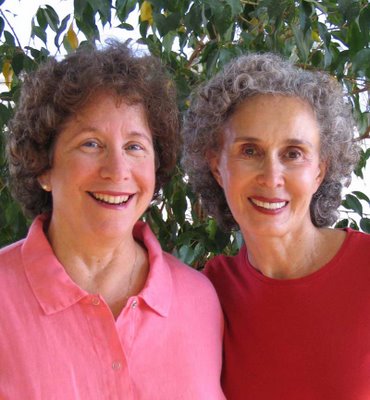
Today we are delighted to welcome
Gary Small, M.D., director of the UCLA Memory and Aging Center and professor of psychiatry at UCLA's David Geffen School of Medicine. He'll be answering our questions - and yours as well - about the book he recently wrote with his wife, Gigi Vorgan, "The Naked Lady Who Stood On Her Head: A Psychiatrist's Stories of His Most Bizarre Cases."
Nourishing Relationships: Several of the stories in your book deal with how the mind affects the body. One of them gets into your experiences with the “Fainting Schoolgirls.” What is mass hysteria? Is it a common phenomenon?
Gary Small: In the “Fainting Schoolgirls” incident, I was investigating an outbreak of illness in a suburban grade school. The kids were rehearsing a performance, when suddenly 30 of them grabbed their stomachs and fainted. The principal told me that it started with one popular child who fainted and suddenly the rest of them went down like dominoes. The health department couldn’t find a cause and gave the “all clear,” but the community was in an uproar. The school seemed to be blocking my efforts to get to the bottom of things, and the parents took offense that a psychiatrist was suggesting that their kids might have had a psychosomatic illness. I nearly gave up my study until I attended the actual show – a little worried that the outbreak might recur – when one of the mothers sought me out and supported my theory of mass hysteria – she was convinced that her daughter’s physical symptoms were in fact psychological. My subsequent research proved my theory that when stressed out, the mind can make the body sick, and in a group setting, it can really get out of control.
When we face uncertainty, our minds crave explanations. If we have no way to account for symptoms, we feel out of control and our fear escalates. And, if we learn that our own minds may have caused these very real symptoms, we tend to feel more anxiety about what our minds might do next. People may worry that their brains are possessed by some outside spirit, or perhaps a poltergeist has taken charge of their willpower. They’d rather latch onto something like the mysterious poisonous water theory. In all the mass hysteria episodes I’ve studied and written about over the years, the lingering question for me is why they don’t happen more often. The essential ingredients – groups under psychological and physical stress, often hungry, tired, or both – come together almost daily all around the world.
NR: Why are people afraid of psychiatrists?
GS: There is clearly a stigma about “seeing a shrink” and admitting one has a problem. Sometimes people are in denial about their mental struggles and avoid or even attack psychiatry in an attempt to avoid anyone discovering their secret psychological issues. Also, mental illness is often perceived as a weakness. Many people still believe that they should be able to solve their problems on their own. Yet, in any given year, an estimated one of four adults—nearly 60 million people in the U.S—suffer from a mental disorder and most of them don’t get help, which is why it is so important for people to try to get beyond their fears.
Psychiatrists are sometimes viewed as probing mental detectives who take control of their patients’ minds rather than heal them. In my book, I attempt to debunk such misconceptions and demystify the treatment of mental illness. Despite the public’s misconceptions, psychiatric treatments diminish and often eradicate symptoms of psychosis, depression, and anxiety. Systematic studies have shown that often combining medicine and psychotherapy results in significant improvement.
NR: Why do you need a therapist if you can talk to a good friend?
GS: A psychiatrist or therapist, unlike a friend, has no agenda of their own when listening. When a friend gives you advice, he may be thinking about how your actions will affect him, as well as you. When you’re in therapy, it’s all about you, not the therapist. Also, anything you tell a therapist is strictly confidential, and unless your friend has the training, you may not be getting the greatest advice. Having good friends is important to our mental health, but if you need it, don’t hesitate to call a professional.
NR: In your book, one of the cases involves a woman who develops a so-called “serial addiction.” What exactly is that and is it really possible?
GS: When we think of addition, alcohol or drugs usually comes to mind, but a person can get addicted to almost anything they enjoy: food, tobacco, sex, gambling, the Internet, or even video games. Some people have addictive personalities. When they “kick the habit” of one thing, they simply move on to something new and get addicted to that. In The Naked Lady Who Stood on Her Head, a woman who has an eating disorder overcomes it. Then, her shopping gets out of control, and she just can’t stop until she moves on to something else. This kind of serial addict usually exhibits the same behavior patterns regardless of the object of their current addiction: They crave the experience all the time, have withdrawal when they can’t get it, are secretive and defensive about the behavior, and the addiction interferes with everyday life. Anyone who’s struggled with addiction or dependency, should be aware of the possibility of becoming hooked on something new.
NR: Another case involves a patient who discovers that her husband has a second wife and family. You give that as an example of a sociopath. How do you define sociopath and how can we tell if someone has that personality disorder?
GS: Sociopaths are people who think only of themselves. They have no conscience or empathy. Whether it’s an Bernie Madoff, Adolf Hitler or Charles Manson, they wreak havoc on other people’s lives. But what about the everyday sociopath who sneaks into your life and befriends you? When you discover his true colors, you’re shocked, you feel violated, and you often blame yourself for being duped. How can you spot these predators before they gain your trust?
First impressions count. If someone does not seem genuine, your impression may be accurate. Also, watch out for people who seem too good to be true. Sociopaths often anticipate your needs in order to get what they really want. Finally, look for typical character traits: no sense of remorse, short-tempered and quick to blame others, and few or no long-term relationships. Remember, sociopaths can be smart and even when you’re on alert, they can slip into your life. Don’t blame yourself, just cut them out and move on.
Thanks so much, Gary! You've given us bites of a delicious idea feast. Now, readers, it's up to you if you want more - he's ready to answer your questions.
Just click on 'comments' at the bottom of this post and follow the prompts. If you don't have an account you can sign in as 'anonymous' - it's as easy as that!
Labels: addiction, advice, aging, anxiety, depression, Dr. Gary Small, Gigi Vorgan, memory, mind/body, stress, UCLA, Virtual Book Tour
 Are your college grads getting ready to move back home?