Family Relationships

Join other women in the sandwich generation - share ideas and solutions as you learn to nourish family relationships without starving yourself.

Monday, July 23, 2012

Reaching Out


In America, we've received another blow to the gut as we are reminded of how lives can change in an instant. The horrific shootings in Aurora, Colorado cast a pale over what was meant to be an entertaining evening respite. Over the weekend, information flowed in from the media, putting individual faces on the victims and outlining many heroic actions of people attempting to shield others from harm and helping those who were already injured.

Ironically, one young woman who was killed, Jessica Ghawi, had earlier survived another shooting at a mall in Canada and had blogged about her experience at that time, I was shown how fragile life was on Saturday. I saw the terror on bystanders' faces. I saw the victims of a senseless crime. I saw lives change. I was reminded that we don't know when or where our time on Earth will end. When or where we will breathe our last breath. Her words are even more haunting now that she is dead.
 
As we face acts of senseless violence like these, we instinctively join together as a community to support one another. When it feels like our safety and security is threatened by an event like this, we seek a solid footing to ground us. We feel less overwhelmed and vulnerable when we experience the touch of another. 

You already know that, in caring for your own family, a hug and kiss can help reduce the pain – emotional and physical. And talking to those in your support system relieves some of your stress, anxiety and fear. So open up to your friends and family about your feelings and thoughts - they can validate your emotions and begin the healing process. And giving a helping hand to others does wonders - it provides aide to those in need and makes you feel useful too.

We may try to understand the reasons behind the attack in an attempt to gain more control over any future chaos. But while so-called pundits will offer explanations about the perpetrator, we really don't yet know what motivated him to conceive of and execute such a terrible plan. What we do know is that reaching out to comfort others in pain and to ask friends and family for support ourselves when we need it creates a resilient, caring community for all of us.

When those under stress join together to sustain each other, we all benefit. Through sharing our common concerns and life experiences we gain a sense of camaraderie, understanding and acceptance. Our mutual support helps diminish the feelings of isolation, anxiety and helplessness and brings a sense of control back into our lives.

In the future we can reflect on what this most recent terrible shooting means to our society but in the meantime, let's join hands with others, empowering us all, and declare our humanity and solidarity with the good in our world.

Labels: , , , , , , , , , , , , , , , , ,

Monday, March 05, 2012

Caution, Curves Ahead

Last week, I was driving down one of the canyons in Los Angeles, quickly moving the steering wheel left and right as the road twisted and turned. It was like playing an arcade game, trying to keep your car on the virtual road, going as fast as you can. In those videos, the sharp curves keep switching and obstacles suddenly appear, causing you to crash and burn if you're not reacting fast enough.

It may be fun to play on a screen but what about when life itself mirrors this wild experience? If you find yourself in the midst of a constant stream of challenges, threatening to devastate you, you're probably looking for a way to tone down the level of your reactions and emotions. Here are two ways to begin:

Give up the illusion of control. If you're a sandwiched boomer, you've probably already noticed that you don't have very much control over the way your growing children or aging parents behave. Juggling work and parenting responsibilities, do you still somehow hold on to the belief that you can determine the way those around you act? This is the time to let go of your unrealistic expectations and the belief that you can create a perfect outcome. What you can change is how you react to what comes your way. Choose to focus on looking inside as you shift to more positive emotions. And turn the challenges coming at you as opportunities for growth.

Give up the guilt. When things don't turn out the way you expect, do you blame yourself? Whether it's trouble maintaining a balance between work and family or your needs and your partner's, don't beat yourself up for your choices - learn from them. Instead of dwelling on past mistakes, forgive yourself, let go of your negative feelings and allow yourself the opportunity to regroup and try something else. You're doing the best you can so give yourself some credit and ease up. After all, you're human, not all-knowing, and you deserve another chance. Friends can give you support and perspective as you share your feelings and concerns.

Stop by again Wednesday for more tips on plotting a course for yourself. And if you're stressed from dealing with the ups and downs of the economy, consider our ebook, Taking Control of Stress in a Financial Storm: Practical Strategies and Resources for Success.

Labels: , , , , , , , , , , , , ,

Wednesday, October 05, 2011

National Breast Cancer Awareness Month

Thriving after any serious illness is complicated and sometimes feels like an uphill struggle. Today's coping tips can help you support yourself - emotionally and physically - along the difficult course of dealing with beast cancer and its treatments.

As you move through this process, you find that staying informed and involved at each step gives a sense of power and resiliency. The National Cancer Institute, a part of NIH, has a wide range of materials to make this job easier. And here are some more tips to help you take charge of your life:

Accept your changing emotions as normal and give yourself permission to express them. After a brush with cancer, it is normal to feel many different emotions such as anger, fear, worry, anxiety, depression, stress or loss of control. It's OK to express these to people you trust and acknowledge them to yourself. Only then can you begin to cope with them.

Recognize the changes in your body. You may feel that your body has betrayed you, leaving you feeling vulnerable and with a loss of innocence about your own invincibility. You may need to grieve this loss. In addition, you may be experiencing side effects of the treatment such as fatigue, stiffness, lymphedema, weight gain, as well as menopausal symptoms. Once you clarify how your body is reacting, you can address each of the symptoms and alleviate them.

Take good care of yourself. Pamper yourself - you deserve it! Follow the guidelines of the American Cancer Society and set aside time for you. Begin an exercise program that includes aerobics, flexibility and strengthening exercises. Enjoy eating a more healthful diet rich in fruits and vegetables. Schedule relaxation time to decrease the stresses in your life. Learn visualization techniques. Think about what you really like to do and do it. Of course this is easier to say than it may be to do, but stick with your decision to make time for yourself. You can make it happen.

Take credit for the challenge you have faced and the changes you are making. Recognize and accept that you have faced many difficulties in your process of healing. Give yourself credit for the hard work you have completed to get to this point in your recovery. You have learned about yourself and made changes in the way you think, feel, act and react to yourself, others and the situation around you.

We celebrate your survival with you! You reflect the unity of women who are surviving breast cancer - and the men who love you.

Labels: , , , , , , , , , , , , , , , ,

Wednesday, April 20, 2011

Making Changes on Days of Celebration


With Tax Day over, this week is a time for family celebrations - Passover for some, Easter for others, and Earth Day for everyone. Earth Day is celebrated this Friday, April 22, as a means of teaching about and appreciating the Earth's environment.

In the wake of these tornadoes, seismic activities, tsunamis and radiation leaks this spring, we all are struck by the realization that changes in the Earth can come in many ways. They can be gradual or sudden and violent. They can come from the forces of nature or from the actions of human beings. They can be unexpected and out of our control or planned and anticipated. In either case, the havoc they reap can affect millions. The effects of the tsunami in Japan have impacted the economy and may continue to do so for weeks to come.

So how then do we come to terms with the tremendous power of Mother Nature? Given the current discussions about whether or not the globe is actually warming - and, if so, whether it's due to man or the earth itself - you may be left feeling confused and overwhelmed. On Earth Day, you can acknowledge the power of nature and still recognize your role in the process.

And in your personal life, you can use these same techniques. Focus on what you can control in your life and what you can accomplish, not what you can't. While you often can't influence circumstances, you can control how you handle them. Clearly define your goals or aspirations and keep focused on them. Letting go of negative thoughts and unrealistic expectations can free you up to make something positive come out of a negative situation.

In the heat of the moment, enthusiasm for making a change - protecting the earth, creating better family relationships, making the world a better place, loosing those stubborn extra pounds - can be great. But what happens the next day? How can you build on your decision to improve? How do you actually vary your routine and transform yourself? Inspiration is not enough - now you need to implement your choice in a clear and definite way. Here are 8 tips on how to go about it:

Acknowledge your ability to change. Recognize that there may be limits to what you can accomplish but that you can take it one baby step at a time. Give yourself permission to begin the process by setting a realistic goal and without expecting perfection in your results.

Write out specific goals for yourself and break them down into smaller, more manageable short-term objectives. Set up a timeline for tackling each task. The more you formulate your plans and establish concrete steps, the greater the likelihood that you will follow up on them.

List your personal resources and inner strengths - they will help you attain your objectives and eventually achieve your goals. Draw on them as you have when you made other changes in your life.

Make a public commitment to the change you are pursuing. This will help you take yourself and your decision seriously and increase your motivation to continue the process even when you face barriers along the way.

Maintain your energy by rewarding yourself for each objective you accomplish even as you keep your focus on the future goals you are striving toward. Positive reinforcement will keep you motivated to continue your process of change.

Draw on the support of family and friends. They want you to succeed and will give you the help you need. Join with others who have similar goals - having someone share your journey makes the whole process more enjoyable.

Don't beat yourself up when you backslide. Change can be overwhelming and you need to be patient with yourself. Refine your strategies as you learn from your mistakes. Have a Plan B ready and continue to improvise as you discover what works best for you.

Enjoy the satisfaction and feelings of power that come from making real changes. You've earned it! And you can use your new skill set to achieve success in other areas of your life as well. If you're a Sandwiched Boomer, resolve to use these tips to take better care of yourself.

Labels: , , , , , , , , ,

Wednesday, January 12, 2011

Optimism about Gabrielle Giffords' and America's Recovery


The recent news has been good concerning the ongoing recovery of Congresswoman Gabrielle Giffords after she was shot point blank in the head on Saturday. Reports are that she is breathing on her own as her husband holds her hand. The outpouring of prayers and good thoughts coming from Americans around the country will help to sustain her and her family through the long and arduous recovery that she faces. Support also goes out to the families of the six murder victims, whose funerals begin tomorrow as 9 year old Christina Taylor Green is laid to rest.

How will the country recover from this tragedy? Will Americans come together to face this heartbreak as one nation or will we be driven apart by finger-pointing and fractious debate? The palpable distress created by the horrific shootings have added to the already high levels of stress identified by the recent national survey conducted by the American Psychological Association.

We hope that such unfathomable horror will never personally touch you or your loved ones, but here are some techniques to use when you are coping with other stresses in your life:

Focus on what you can control and what you can accomplish, not what you can't. Close to one-half of those surveyed by APA said they experienced irritability and anger as a symptom of stress. While you often can't influence circumstances, you can recognize your emotions and control how you handle them. To move away from frustration, let go of negative thoughts and unrealistic expectations. Clearly define your goals or aspirations and keep focused on them. Make something positive come out of a negative situation.

Draw on your strengths. Survey respondents readily admitted their lack of willpower in creating a healthier lifestyle but 70% believe they can improve and institute the changes they have identified. Use the personal strengths you have relied on in the past as well as those you have developed more recently. Brainstorm new ways to apply the abilities you have in a novel way as you generate new opportunities for yourself.

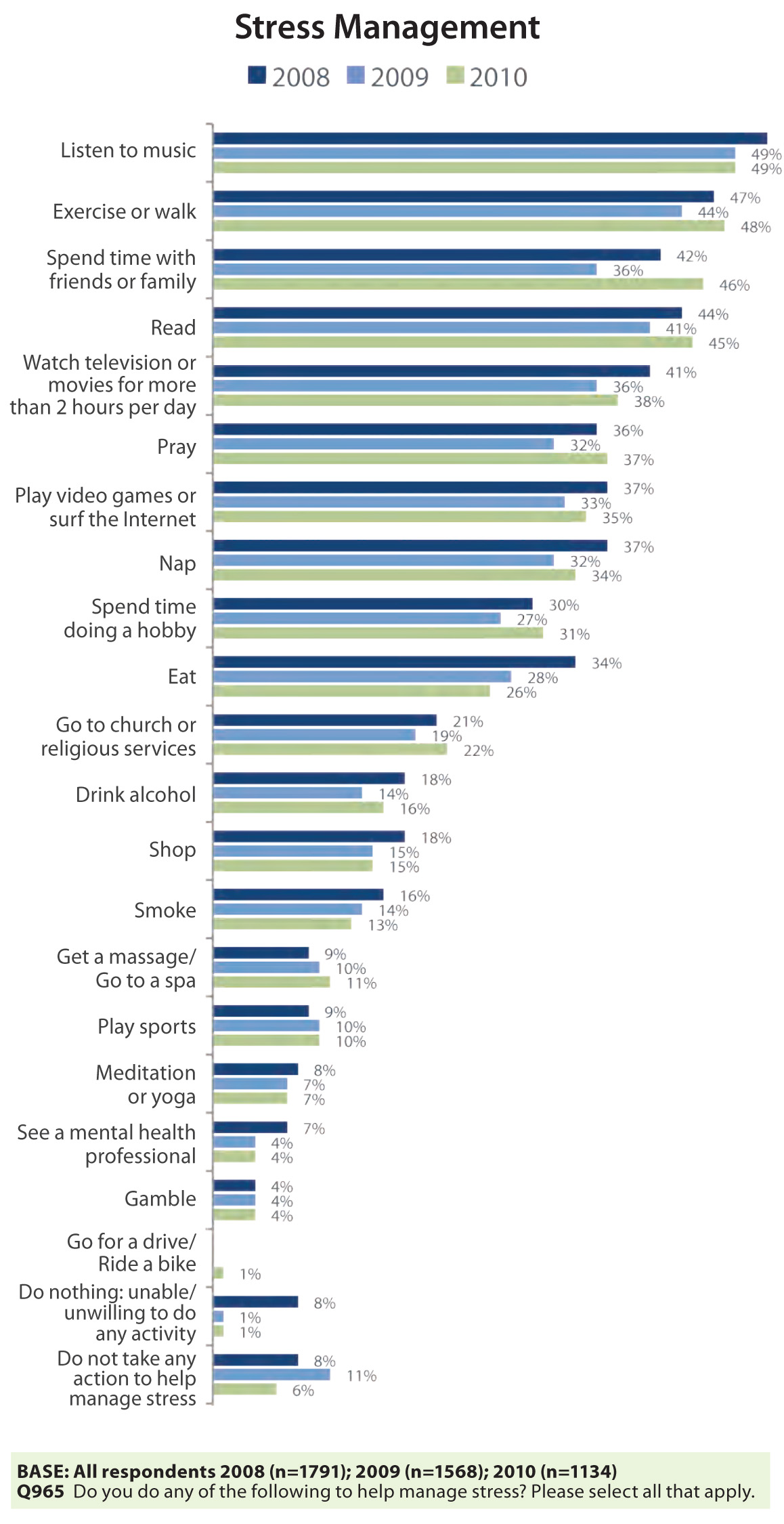
Be patient with yourself. Know that you will recover balance and serenity at your own pace. As long as you keep moving forward, you will eventually reach your destination. Like one-half of survey respondents, you may find that listening to music, exercising, spending time with family or friends and reading are comforting ways to manage your stress.

Talk about your thoughts and feelings with family and friends and reach out to others in your support system. Be open to asking for help and validation of your emotions. You may want to consult a professional counselor for a non-judgmental ear and help in sorting out your concerns. Start a journal to aid in the process of coping with your anxiety.

You'll likely find that your personal recovery, both physical and emotional, will take time. Support is valuable as you begin the process of rebuilding body and spirit and restoring hope as you cope with your own feelings of stress and anxiety. And the American Psychological Association has more tips for coping with stress in the aftermath of traumas such as these horrific shootings.

Labels: , , , , , , , ,

Wednesday, October 20, 2010

Surviving Breast Cancer

As you recognize from all the pink ribbons around, October is National Breast Cancer Awareness month. Yet soon the month will be over and done - just as breast cancer can be diagnosed and treated. Between 2 and 3 million American women today have survived this health challenge and are living cancer-free. But thriving after any serious illness is complicated and sometimes feels like an uphill struggle.
Breast cancer awareness ribbon

Today's coping tips can help you support yourself - emotionally and physically - along the difficult course of dealing with breast cancer and its treatments. As women move through this process, many find that staying informed and involved at each step gives them a sense of power and resiliency. The National Cancer Institute, a part of NIH, has a wide range of materials to make this job easier. Here are some more tips from us to help you take charge of your life.

Take good care of yourself. Pamper yourself - you deserve it! Follow the guidelines of the American Cancer Society and set aside time for you. Begin an exercise program that includes aerobics, flexibility and strengthening exercises. Enjoy eating a more healthful diet rich in fruits and vegetables. Schedule relaxation time to decrease the stresses in your life. Learn visualization techniques. Think about what you really like to do and do it. Of course this is easier to say than it may be to do, but stick with your decision to make time for yourself. You can make it happen.

Redirect yourself toward active goal setting. When a serious illness strikes, you may feel like your life is completely out of control. To regain a sense of direction, reflect on what priorities are important to you and then set a goal within your reach. Identify your strengths and build on them as you plan how to achieve your objectives. Journaling may be helpful as you consider strategies and options. Initiate your plan in small steps and review your progress regularly.

Make something positive come out of the situation. Women who are able to find some positive meaning in such a negative situation often experience growth as well as a greater sense of control and feelings of confidence and optimism. Think about how you can use the unique perspective you have gained to make the rest of your life richer and more meaningful. Nancy G. Brinker supported her sister Susan in her unsuccessful fight against breast cancer and later founded Susan G. Komen for the Cure. It has become the world's largest grassroots network of breast cancer survivors and activists and the largest source of nonprofit funds dedicated to winning the fight Susan ultimately lost.

Take credit for the challenge you have faced and the changes you are making. Recognize and accept that you have faced many difficulties in your process of healing. Give yourself credit for the hard work you have completed to get to this point in your recovery. You have learned about yourself and made changes in the way you think, feel, act and react to yourself, others and the situation around you.

You can read one woman's story about her experiences with breast cancer on our website in an early newsletter. Feel free to browse around and read other archived newsletters that interest you. Then sign up to receive your own copy of our free monthly newsletter in its new format, Stepping Stones, emailed directly to you. When you do, you'll receive a complimentary copy of our ebook, Courage and Lessons Learned.

Labels: , , , , , , , , , , , , , , ,

Thursday, January 28, 2010

Coping with Stress and Anxiety

Senior woman on the beach


You may be feeling anxious because of the economic meltdown, security fears brought on by acts of terrorism or natural disasters such as the earthquake in Haiti. Whatever the reason for your high level of stress, if you want to keep it in check, try on the following tips to restore a sense of hope to your life:

Use relaxation techniques. Set aside time for a regular routine of deep breathing, guided imagery, meditation, or other stress reduction methods to alleviate your feelings of anxiety. Decide to put off worrying - much of what we fear never actually happens anyway.

Focus on what you can control in your life and what you can accomplish, not what you can't. Let go of negative thoughts and unrealistic expectations. While you often can't control circumstances, you can control how you handle them. Clearly define your goals or aspirations and keep focused on them. Make something positive come out of a negative situation just as people across the world did in providing aid to Haiti after the devastating earthquake there.

Draw on your strengths. Use those you have relied on in the past as well as those you have developed more recently. Brainstorm new ways to apply the abilities you have in a novel way as you create new opportunities for yourself.

Be patient with yourself. Know that you will recover your balance and serenity at your own pace. As long as you keep moving forward, you will eventually reach your destination.

To learn more about strategies to help meet the challenges of the Sandwich Generation, visit our website, www.HerMentorCenter.com. And click on the post title above to be linked to our article there, Top Ten Self-fullness Tips for Sandwiched Women.

Labels: , , , , , , , , ,

Link

Thursday, October 15, 2009

NBCAM and Dealing with Breast Cancer


As women move through the steps of coping with breast cancer and its treatments, many find that staying informed and involved in the process gives them a sense of power and resiliency. Here are some more tips to help you take charge of your life.

Redirect yourself toward active goal setting. When a serious illness strikes, you may feel like your life is completely out of control. To regain a sense of direction, reflect on what priorities are important to you and then set a goal within your reach. Identify your strengths and build on them as you plan how to achieve your objectives. Journaling may be helpful as you consider strategies and options. Initiate your plan in small steps and review your progress regularly.

Make something positive come out of the situation. Women who are able to find some positive meaning in such a negative situation often experience growth as well as a greater sense of control and feelings of confidence and optimism. Think about how you can use the unique perspective you have gained to make the rest of your life richer and more meaningful.

When you feel like it is almost too much to get started making a change, reflect on how inertia can hamper your efforts to cope. Click on the post title above to take you to our website and the article, "Sandwiched Boomers: 7 Tips on Fighting Inertia." They will help give you just the push you need to begin.

Today's pink ribbon is by Rachel Meinz and can be found on Carol Sutton's site, http://www.carolsutton.net/download_pink-ribbon.html

Labels: , , , , , , , , , , , , ,

Link

Tuesday, July 07, 2009

Video Tips for Regaining Control in Financial Chaos

With the stimulus package having little effect and the continued loss of jobs, the recession appears to be continuing unabated. Still, you, and other Sandwiched Boomers, can regain some control over your situation by educating yourself, evaluating your finances and making the hard decisions that lead to changes in your lifestyle. Watch our video for more coping tips.


To read some tips about how to maintain and even strengthen your family relationships during this time of financial belt-tightening, click on the title above. It will link you to wwwHerMentorCenter.com and our article, "Marital Harmony Despite Financial Woes."

Labels: , , , , , , , , ,

Link

Wednesday, November 26, 2008

As a longstanding member of the Sandwich Generation, are you tired of preparing the Thanksgiving dinner and ready to pass the baton to the next generation? What follows are some tips that will help you create new holiday rituals:

Make this Thanksgiving a rite of passage. If you want to be a guest instead of the hostess, tell your family how you feel. Whether you're edging your kidults out of the nest or taking a well deserved break, begin to shift the responsibility of family get-togethers to the next generation.

Pass on the family legacy. Let your adult children know how much you value keeping the family close. Ask for what you want and be willing to help out. Teach by example as they watch how you lovingly take care of your own aging parents.

Encourage your children to preserve the old family traditions. Give them your support while they begin to create some new customs of their own. And remember to express your appreciation for all they do.

Whether your emerging adult children decide to create new wave recipes or cook the meal in the microwave, it's now out of your control. Sit back and relax - all you have to do is pass the cranberries.

Labels: , , , , , , ,

Thursday, October 02, 2008

As you begin to feel more confident about yourself and the decisions you make, you can decrease some of the stress you are feeling as a Sandwiched Boomer.

Take control of what is within your reach. And have the wisdom to know the difference between what you can manage and what you can't. In addition, recognize that you don't have to do it all alone. Make the decision to ask for help whenever you need it.

Work on feeling more empowered and get involved in a culture that supports this. Be grateful for what you have by getting outside yourself. Put the focus on others in need – become a mentor to at-risk youths or share your skills and experience with a homeless shelter.

Tomorrow we will finish our tips for managing the stresses in your life - vital in this time of economic uncertainty.

Labels: , , , ,