Family Relationships

Join other women in the sandwich generation - share ideas and solutions as you learn to nourish family relationships without starving yourself.

Wednesday, April 25, 2012

Virtual Book Tour: Lauren Brooks and Kettlebells

We’re pleased to be hosting Lauren Brooks here on the blog today. She’s the author of Kettlebells for Women: Workouts for Your Strong, Sculpted and Sexy Body.

For those of you who don’t know, kettlebells are iron balls with handles that allow you to move the weight in a natural swinging motion with your hips. They provide an all in one workout that results in increased strength, conditioning and fat loss all at once. If you’re ready to know more about this unusual and effective kind of workout, let’s get started:

Nourishing Relationships: We all know how passionate you are about teaching kettlebells. Please tell us a little more about what inspired you to write this book for women.
Lauren Brooks: Writing a book about kettlebells allowed me to take everything that I’ve learned and believe in and put it down in an easy and welcoming step by step format. For the last 7 years, I have watched hundreds of transformations in people who have added kettlebells into their life. Many have had the opportunity to use my kettlebell DVDs. The majority of my fan base is female because my experiences made it easy for them to relate to me not only as a woman, but also as a mother who has gone through two pregnancies.

Many women have this fear that if they lift anything heavy they will get big and bulky muscles and thus not look feminine anymore. Others may glance at a kettlebell and immediately think, “There is no way I can do that, it looks too hard and I will probably hurt myself.” I am hopeful that my book will prove to women of all ages and fitness levels that they too can learn how to successfully incorporate kettlebells into their fitness regimen.

NR: Can you tell me a little about why you chose the book cover that you did? Most female fitness books have someone looking more cheery. Why the serious look?

LB: The serious look was to highlight that this book cuts right to the chase. There’s no fluff or fillers. I wanted to show that it’s all about building strength and toughness, yet leaves room for plenty of femininity. There is a time and place for cheeriness, but “Kettlebells for Women” is about focus.

NR: What would you say is the main premise of your book?
LB: This book is about showing women of all ages that they can unleash an incredible power inside themselves. No matter what fitness level or age, any woman will benefit tremendously by increasing her strength and conditioning in this primal way of movement. The feeling of being empowered, confident, and incredibly sexy is exactly what has happened for the ladies whom I know have incorporated kettlebells into their life. This book guides you in such a way to make it easy enough for anyone to follow. I’ve seen that even husbands, along with men in general, are getting inspired to join their women in these workouts. Like any new exercise, having several private sessions would ensure safety. However, once the form and technique is achieved, the beauty of this program is it can be done almost anywhere.

NR: I understand you have released 6 workout DVDs. Would you say that the book is a better option to start with?
LB: For the last 4 years people all over the world have been learning from and working out to my kettlebell DVDs. I generally recommend beginning with my first DVD, “The Ultimate Body Sculpt and Conditioning with Kettlebells,” since it has an extensive tutorial section along with a couple of follow along workouts. My workout partner in that DVD is in her mid 50’s and she truly sets the bar high as far as what people are capable of doing at any age. The book is a perfect companion to any of my DVDs. It breaks down around 100 different exercises using pictures and descriptions, which should enhance the learning curve.

NR: Is this something that people of any age and fitness level can benefit from?
LB: I have personally worked with women and men of all ages and all fitness levels. It’s getting very popular for the baby boomers since it’s approachable, fun, doesn’t take a long time out of the day and the results are fantastic. I have lots of happy clients who are between the ages of 30 and 80. They are all reaping the benefits of moving better and improved strength and conditioning, thanks to this easy, no nonsense approach to healthier living. Chronic knee pain is suddenly diminished along with hip and shoulder pain. Glutes are firming up, arms are toning, and everything else in life, such as carrying groceries, playing with children and improving in all sports for that matter, is just getting better!

NR: Where can I find the book and how do I get started?
LB: The best way to get started is to purchase a kettlebell ranging in weight anywhere from 15-18 pounds. I know that sounds like a lot, but it’s much lighter than you think when it’s used properly. My 50 and 60 year old clients are currently able to swing 53 and 60 pound kettlebells with ease! They are little ladies too! You can find the book and DVDs on my website. I look forward to hearing from everyone and can’t wait to hear about more journeys of optimal strength, fitness, health and happiness.

Thanks for taking the time to talk with us today, Lauren. Learn more about Lauren and her work on her Facebook page. And now, readers, it’s your turn. I know you have some questions as well as concerns about your fitness program. Lauren will be checking in throughout the day - so here's your chance - just click on "comments" below and fire away.


Labels: , , , , , , , , , , ,

Monday, January 09, 2012

Becoming Your Own Expert

Are you tired of hearing the same ole, same ole…the "experts" telling you what to do? Everywhere you look this time of year, you can find someone waxing on about what kind of New Year's resolutions to set for yourself and how to achieve them. But really, don't you know yourself better than anyone else does? So how about treating yourself as the expert for a change and listen to your own voice.

You don't need to have anyone lecture you that adding a walking routine to your schedule will help you feel better, physically and emotionally, in 2012. You already have that awareness - but is that enough to get you out the door?


Photo by L.E. Erickson - Flickr.com

You could remind yourself that research has shown walking helps in weight control as well as in reducing the risk of cardiovascular disease. Or that it works to increase your brain flexibility and decrease memory loss. Or even that brisk walking can provide a cushion against symptoms of depression.

But you know all of that. You understand that walking is the most uncomplicated exercise, the easiest to implement and one that is so flexible that you can tailor it around your own schedule. You can begin at any age or level and increase the speed and length during the year. And you can add in the benefits of social companionship or an appreciation of nature if you like.

So what's holding you back? Think about it. It could be your physical condition and a fear of hurting yourself. But more likely it's about inertia or setting your priorities. If you haven't made a public commitment to change, it's less likely that you'll actually go ahead with the new behaviors you want to implement. Identify what your own personal obstacles are and visit our blog again on Wednesday for some suggestions to help you ramp up the volume of your inner voice so you can make the changes you've set for yourself in 2012.

Labels: , , , , , ,

Wednesday, December 28, 2011

Thinking About Your New Year's Resolutions

Now that you've made the exchanges in your Christmas or Chanukah gifts, do you think it's time to begin thinking about the changes you want to make in yourself this coming New Year?

You may have your own unique list of improvements you want to make - stop smoking, lose some extra pounds, exercise more, live a healthier lifestyle, spend quality time with family and friends. No matter what makes up your set of New Year's Resolutions, change is never easy. If you're wondering what can help you take that first step, here are some ideas to keep in mind as you get started:

Photo courtesy of husin.sani - Flickr.com

Be open to trying something new. Let your creativity flourish as you open yourself up to new possibilities. You can strive for something that may have eluded your grasp in the past. Search for a different way to get to where you want to be.

Keep your resolutions realistic. When you honestly believe that you can attain your target, you'll work harder to move in that direction. Setting overly ambitious, idealistic targets that you're unlikely to reach can stop you cold even before you begin.

Break your goals down into smaller parts that you can complete, one at a time. Baby steps taken one after another will transport you a long distance. You'll feel freer to continue knowing that each objective is within your reach.

Visualize yourself accomplishing each objective you set. Athletes are more successful after envisioning themselves playing well. When you create a picture in your mind of going through each step you need to succeed, you'll find that the process is easier to finish.

As you likely know, making the commitment to change is only the first part of actually achieving your goals. It can be difficult to stay on track and backsliding often becomes an issue. But you don't have to do it alone. Visit our blog often in 2012 for practical tips to help you stay motivated and chart your progress as you move forward toward accomplishing your New Year's resolutions. When you reach your target, you'll recognize that all your hard work was well worth it.

Our very best to you for a safe and happy, healthy New Year as we welcome in 2012.

Labels: , , , , , , , , , ,

Wednesday, November 09, 2011

Ways to Lose Weight - A Baker’s Dozen


We welcome our guest blogger, Sandi Thompson, a nutritional therapy practitioner and certified wellness coach who is here today sharing her tips about how to lose weight:

There was an article in the Los Angeles Times about the grim data on U.S. obesity. There's only one state with an obesity rate under 20% - Colorado squeaked in at 19.8. Compare that to Mississippi with a rate of 34.4%. That means over a third of their population is not just overweight but downright FAT.

What can you to do? Here are 13 simple tips to take the bathroom scale in the other direction:

Slow down and chew your food. Quit inhaling it. Give your stomach time to signal your brain that you are full. This takes about 20 minutes. Have you lost the pleasure of dining and exchanged it for gulping?

Put your fork down between bites. This really slows down your eating, allowing you to savor your food.

Eat fruit between meals instead of grabbing a latte and a cookie. Your mid-morning and mid-afternoon hunger can be healthy - some nuts, a piece of fruit, maybe some crunchy carrots and a piece of cheese. A stroll at this time of day helps get your blood circulation going and that’s good if you have a desk job.

Stop drinking anything about 20 minutes before a meal. This creates a better environment in your stomach for digestion. If you have to drink with your meal, take small sips. Better digestion means more nutrients are absorbed. You may experience fewer cravings.
Go for a walk after dinner. This doesn’t have to be a race. A 20 minutes family walk after loading the dishwasher can take pounds of the scale and inches off your waist. It’s okay to stop and smell your neighbor’s flowers, but keep going.

Step up your exercise gradually. Start by parking further away at the grocery store or the office. Go for the parking place that allows you to stretch your legs a bit, not the one right beside the door. Over time, this little change pays off.

Leave temptation on the shelf at the store. If you want a treat make it healthy like a piece of fruit. Keep the ice cream, cookies, candies, cake, chips and crackers out of your home and you will have a better chance of losing weight.

Open your mind to new ways to celebrate success. Instead of a big night out and a huge meal to congratulate yourself, how about tickets to a concert, a play, an overnight trip, a sports event or something else that doesn’t center on food. How about a new pair of shoes? That makes me happy!

Scan the buffet line BEFORE filling your plate. It is easier to make better choices that way.

Aim for feeling full instead of stuffed when you get up from the table. One way to do this is concentrate on eating greens like salad or cooked vegetables along with protein and pass on the starches like potatoes, rice and bread.

Keep yourself hydrated. We often mistake thirst for being hungry. Try this for a week: instead of grabbing coffee in the morning when you get up have 8-16 ounces of water. Sip water throughout the day and aim for 8 glasses. Dehydration can sometimes be diagnosed as dementia in the elderly.

Read labels and make good choices. Keep the grams of sugar in packaged foods to 7 grams or less per serving. It’s often the sugar in our food that keeps us fat, not just high fat foods. Sugar seems to fuel our appetite for even more sweet foods. Wean yourself off sweets and you’ll see the pounds disappear.

Lose the soda. There is nothing good about soda. It’s loaded with calories if it’s regular soda and loaded with artificial sweeteners if it’s diet soda. Either way, it’s loaded with chemicals and it doesn’t hydrate you the way water does. Plus, diet soda can actually make you crave more calories and sugary foods.

Thanks for your wise and practical advice, Sandi. And if you want to learn more about Sandi and what she does, log on to her website, Facebook page or YouTube channel.

Labels: , , , , ,

Monday, October 24, 2011

How to Exorcise Ghosts from the Past

Although Halloween today revolves around trick-or-treating and costume parties, in the past masks were worn to placate the evil spirits. You may not believe in witches and goblins, but when was the last time you thought seriously about ghosts that haunt you?

Your thoughts are mental products although they don't necessarily reflect an absolute reality. However, for you, they do represent how you feel. The bad feelings you have may be due to normal temperament, stress overload, situational sadness or even clinical depression. Did you know that 1 in 4 people actually suffer from depression at some time in their lives and close to 50% do not receive treatment? If you have had extreme sadness or feelings of helplessness and hopelessness for over two weeks, it's best to schedule an appointment with your medical professional to assess your symptoms and, if necessary, refer you to a specialist.

When there is no obvious trigger, do you try to minimize, ignore or dismiss how you feel? Instead, here are some ideas to help you better understand your negative emotions. You can learn how to reframe your thoughts and take better care of your emotional self. Begin by following these social support and self-care tips:

Honor your body to improve physical and emotional wellbeing. Pay attention to your exercise routine, your sleeping pattern and what gives you pleasure. Try to stay away from situations that cause stress and increase the ones that make you feel more relaxed and alive.

Focus on what you can accomplish rather than on what you can't. Look on the bright side of difficult situations as you create a balance between caring for others and your own needs. Take at least half an hour and read a book, listen to music or call a friend - it may help to mark it in your schedule until it becomes a regular part of your day. Although you can't always control external circumstances, you can control how you handle them.

Explore our website, Her Mentor Center for articles about what impacts the emotions of your family relationships as well as yourself. And log on here Wednesday for more practical insights that can help you beat the blues.

Labels: , , , , , ,

Wednesday, October 05, 2011

National Breast Cancer Awareness Month

Thriving after any serious illness is complicated and sometimes feels like an uphill struggle. Today's coping tips can help you support yourself - emotionally and physically - along the difficult course of dealing with beast cancer and its treatments.

As you move through this process, you find that staying informed and involved at each step gives a sense of power and resiliency. The National Cancer Institute, a part of NIH, has a wide range of materials to make this job easier. And here are some more tips to help you take charge of your life:

Accept your changing emotions as normal and give yourself permission to express them. After a brush with cancer, it is normal to feel many different emotions such as anger, fear, worry, anxiety, depression, stress or loss of control. It's OK to express these to people you trust and acknowledge them to yourself. Only then can you begin to cope with them.

Recognize the changes in your body. You may feel that your body has betrayed you, leaving you feeling vulnerable and with a loss of innocence about your own invincibility. You may need to grieve this loss. In addition, you may be experiencing side effects of the treatment such as fatigue, stiffness, lymphedema, weight gain, as well as menopausal symptoms. Once you clarify how your body is reacting, you can address each of the symptoms and alleviate them.

Take good care of yourself. Pamper yourself - you deserve it! Follow the guidelines of the American Cancer Society and set aside time for you. Begin an exercise program that includes aerobics, flexibility and strengthening exercises. Enjoy eating a more healthful diet rich in fruits and vegetables. Schedule relaxation time to decrease the stresses in your life. Learn visualization techniques. Think about what you really like to do and do it. Of course this is easier to say than it may be to do, but stick with your decision to make time for yourself. You can make it happen.

Take credit for the challenge you have faced and the changes you are making. Recognize and accept that you have faced many difficulties in your process of healing. Give yourself credit for the hard work you have completed to get to this point in your recovery. You have learned about yourself and made changes in the way you think, feel, act and react to yourself, others and the situation around you.

We celebrate your survival with you! You reflect the unity of women who are surviving breast cancer - and the men who love you.

Labels: , , , , , , , , , , , , , , , ,

Wednesday, August 17, 2011

How to Decide Which Tour Group is Best for You

Most group tours today consist of Boomers and those 10 years younger. Since we are the generation of joggers, exercise bikers, and elliptical skippers, we are more active and fit than many of our parents. They were happy to sit on a bus and look out of the windows on their first trips overseas. How can a Boomer determine if a tour is too sedentary or too active for her level of fitness? Here are some tips from a fairly fit, though sometimes lazy Boomer traveler and tour operator:

Look at the photos of people in the travel brochure. Do they look like you? What kind of shoes are they wearing? Too dressed up, they are not doing 2 hour walking tours of Rome. Too sporty with hiking boots, they might be outpacing you on a climb to the top of a Turkish hill fort. Their hairstyles will also tell you if this is a casual group or one that ‘dresses for dinner’.

What is the pace of the itinerary? Too many included meals mean a lot of sitting around. More than a half-day bus tour per day means very limited activity. Choose a tour that has a mix of meals, bus tours, free time and some early arrival days at the hotel. Why early arrival? If you have eaten a 4 course French lunch with mousse, then you will want some time to exercise or to take a long walk. Most hotel gyms overseas will be small and, in a European hotel, very limited in scope.

Check the schedule of events for the trip. Factor in your personal tolerance for altitude, dryness, sea level humidity, heat, cold etc. An example is if you go to countries like Guatemala, Costa Rica or Mexico, check the altitude and let your body adjust before you climb the mountain to get the best view. Or if you live in a high city like Denver, you will probably want adjustment time before you do your early morning jog in humid Honduras. I was once on a trip to China with 3 women from the Virgin Islands. They were used to the tropics and to drinking lots of water. Beijing is very dry and it was a cool day. They did not realize how dehydrated they were until one of them turned a weird color and fainted!

Find out how large the group is. A small group moves faster than a group of 50 due to general loading of buses, check-in at airports, delivery of luggage etc.

See if the tour you choose includes a rating for physical exertion. And if not, just be sure you can handle everyday obstacles like cobbled stones in Sicily, broken stairs leading to a Thai temple, sandy walks in Ephesus, steep staircases in the Marinsky Opera House. I am a strong advocate for limited luggage. There will always be one time when you must handle your luggage, even if it is in your hotel room moving from one area to another.

Click on 'Comments' below and follow the prompts - you can even sign on as Anonymous, it's as easy as that! Then ask our guest blogger, Phyllis Stoller, your travel questions. And share your adventure stories with other readers as well.

Labels: , , , , ,

Wednesday, March 23, 2011

Building Resiliency After the Disasters in Japan


The Japanese concept of gaman - strength, patience, discipline - is evident in the reactions of the people there to the cascade of disasters that have hit them: earthquake, tsunami, nuclear contamination. In the midst of widespread damage, they are grieving their tremendous loss of lives and property but are also determined to endure and already beginning to rebuild. With the tradition of working together and an attitude that "everything will be all right," the Japanese people are hoping to move forward.

What can we learn from the people of Japan about resiliency in the face of tragedy? World events - and the 24/7 news about them - contribute to the anxiety and tension we feel on a daily basis. Without the effect of these outside events, the most frequently cited sources of stress in the recent American Psychological Association survey were money, work and the economy. Over one-half of the respondents also noted that family responsibilities and relationships were significant causes of chronic stress. Today, added to that, people are experiencing additional anxiety, though out of harm’s way themselves, because of the uncontrollable events that have hit Japan.

Coping with stress is important for building resiliency and maintaining our physical as well as mental health. Earlier this week on the blog we talked about four strategies to use when you are feeling overwhelmed. Here are five more suggestions for you to use now and on a regular basis:

Practice relaxation techniques. Set aside time for a regular routine of deep breathing, guided imagery, meditation or other stress reduction methods. Decide to put off worrying - much of what you may fear never actually happens anyway. Remember to be open to the healing effects of laughter.

Exercise several times a week. Only one-quarter of Americans surveyed by APA were satisfied with their level of physical activity. To increase yours, find an activity that you enjoy and stick with it - walking with friends, water aerobics, pilates or yoga classes, training at the gym.

Eat sensibly. Resolve to maintain a balanced diet of healthy foods rich in nutrition that serve as a natural defense against stress. Avoid the use of drugs and alcohol to self-medicate and limit your use of sugar, caffeine and cigarettes as they can contribute to anxiety.

Reach out to your support system. Ask for help. Talk about your thoughts and feelings with family and friends - they can validate your emotions. You may want to consult a professional counselor for a non-judgmental ear and guidance in sorting out your concerns.

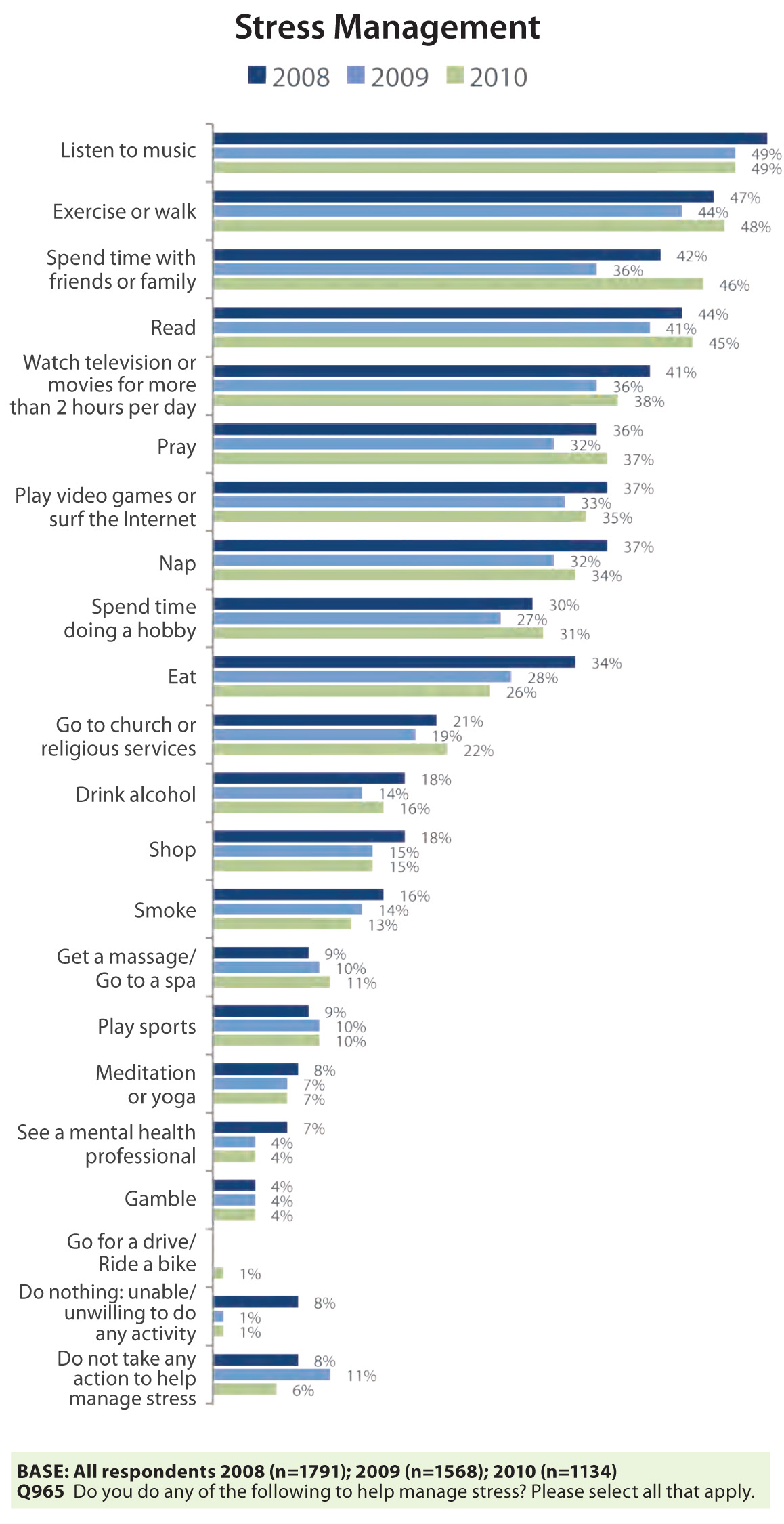
Be patient. Know that you will recover balance and serenity at your own pace. As long as you keep taking steps to move forward, you will eventually reach your destination. Like one-half of survey respondents, you may find that listening to music, exercising, spending time with family or friends and reading are comforting ways to manage stress.

Close to one-half of those surveyed by the American Psychological Association said they experienced irritability and anger as a symptom of stress. The APA has compiled a stress tip sheet to help reduce these kinds of negative emotions. You can learn to manage stress and become more resilient when you practice the strategies we've focused on this week. Nevertheless your emotional recovery, like the Japanese, will take time. Support - both for yourself and what you provide to others - is valuable as you begin the process of rebuilding and restoring hope in these difficult days.

Labels: , , , , , , , , , , ,

Wednesday, January 12, 2011

Optimism about Gabrielle Giffords' and America's Recovery


The recent news has been good concerning the ongoing recovery of Congresswoman Gabrielle Giffords after she was shot point blank in the head on Saturday. Reports are that she is breathing on her own as her husband holds her hand. The outpouring of prayers and good thoughts coming from Americans around the country will help to sustain her and her family through the long and arduous recovery that she faces. Support also goes out to the families of the six murder victims, whose funerals begin tomorrow as 9 year old Christina Taylor Green is laid to rest.

How will the country recover from this tragedy? Will Americans come together to face this heartbreak as one nation or will we be driven apart by finger-pointing and fractious debate? The palpable distress created by the horrific shootings have added to the already high levels of stress identified by the recent national survey conducted by the American Psychological Association.

We hope that such unfathomable horror will never personally touch you or your loved ones, but here are some techniques to use when you are coping with other stresses in your life:

Focus on what you can control and what you can accomplish, not what you can't. Close to one-half of those surveyed by APA said they experienced irritability and anger as a symptom of stress. While you often can't influence circumstances, you can recognize your emotions and control how you handle them. To move away from frustration, let go of negative thoughts and unrealistic expectations. Clearly define your goals or aspirations and keep focused on them. Make something positive come out of a negative situation.

Draw on your strengths. Survey respondents readily admitted their lack of willpower in creating a healthier lifestyle but 70% believe they can improve and institute the changes they have identified. Use the personal strengths you have relied on in the past as well as those you have developed more recently. Brainstorm new ways to apply the abilities you have in a novel way as you generate new opportunities for yourself.

Be patient with yourself. Know that you will recover balance and serenity at your own pace. As long as you keep moving forward, you will eventually reach your destination. Like one-half of survey respondents, you may find that listening to music, exercising, spending time with family or friends and reading are comforting ways to manage your stress.

Talk about your thoughts and feelings with family and friends and reach out to others in your support system. Be open to asking for help and validation of your emotions. You may want to consult a professional counselor for a non-judgmental ear and help in sorting out your concerns. Start a journal to aid in the process of coping with your anxiety.

You'll likely find that your personal recovery, both physical and emotional, will take time. Support is valuable as you begin the process of rebuilding body and spirit and restoring hope as you cope with your own feelings of stress and anxiety. And the American Psychological Association has more tips for coping with stress in the aftermath of traumas such as these horrific shootings.

Labels: , , , , , , , ,

Monday, January 10, 2011

Congresswoman Gabrielle Giffords and Stress in America


The weekend shooting of Congresswoman Gabrielle Giffords - and the attendant murders of six bystanders - has again pushed the American psyche into overload. Though out of harm’s way themselves, many people experience stress and anxiety when faced with these kinds of uncontrollable situations. While it appears the gunman's serious mental illness motivated the shooting spree, the horrendous act itself has raised stress levels all across the United States, already high due to the poor economic climate. In fact, a recent national health survey found that 75% of the general population experiences at least some stress every two weeks, with half of these rated at moderate or high levels.

According to the American Psychological Association, key findings from their recent survey indicate that stress levels have increased over the past five years, impacting both physical and emotional health. Most Americans are feeling moderate to high stress levels, with many feeling overwhelmed and emotionally exhausted. The most frequently cited sources of stress are concerns about money, work and the economy. Nearly one-half of those who participated in the survey were fearful about their job stability. Over one-half also noted that family responsibilities and relationships were significant causes of stress.

What can you do to reduce your stress levels and take better care of yourself now and during the rest of 2011? The American Psychological Association has some suggestions to manage your distress in the aftermath of the shooting. And here are some of our tips to get you started:

Maintain balance in your life between personal needs, work and your family obligations. Don't over commit yourself even as you retain a normal routine. Carve out some special time for yourself even in the midst of caring for your growing children and aging parents.

Exercise moderately several times a week. Only one-quarter of those surveyed were satisfied with their level of physical activity. To increase yours, find an activity that you enjoy and will stick with - walking with friends, water aerobics, dance or yoga classes, training at the gym.

Eat sensibly, following a balanced diet of healthy foods rich in nutrition that serve as a natural defense against stress. Avoid the use of drugs and alcohol to self-medicate and limit your use of sugar, caffeine and cigarettes as they can contribute to your anxiety. Get enough rest and sleep to allow your body to recover from the stresses of the day. Over 40% of the survey respondents reported feeling fatigued on a regular basis and lacking in energy.

Use relaxation techniques. Set aside time for a regular routine of deep breathing, guided imagery, meditation, or other stress reduction methods. Decide to put off worrying - much of what you may fear never actually happens anyway. Remember to be open to the healing effects of laughter.

Using these tips can help you become more resilient as you cope with the stresses around you on a daily basis. And to learn more about how you can manage the pressures you face in our economic downturn, check out our ebook, Taking Control of Stress in a Financial Storm: Practical Strategies and Resources for Success.

Labels: , , , , , , , , , , ,

Wednesday, October 20, 2010

Surviving Breast Cancer

As you recognize from all the pink ribbons around, October is National Breast Cancer Awareness month. Yet soon the month will be over and done - just as breast cancer can be diagnosed and treated. Between 2 and 3 million American women today have survived this health challenge and are living cancer-free. But thriving after any serious illness is complicated and sometimes feels like an uphill struggle.
Breast cancer awareness ribbon

Today's coping tips can help you support yourself - emotionally and physically - along the difficult course of dealing with breast cancer and its treatments. As women move through this process, many find that staying informed and involved at each step gives them a sense of power and resiliency. The National Cancer Institute, a part of NIH, has a wide range of materials to make this job easier. Here are some more tips from us to help you take charge of your life.

Take good care of yourself. Pamper yourself - you deserve it! Follow the guidelines of the American Cancer Society and set aside time for you. Begin an exercise program that includes aerobics, flexibility and strengthening exercises. Enjoy eating a more healthful diet rich in fruits and vegetables. Schedule relaxation time to decrease the stresses in your life. Learn visualization techniques. Think about what you really like to do and do it. Of course this is easier to say than it may be to do, but stick with your decision to make time for yourself. You can make it happen.

Redirect yourself toward active goal setting. When a serious illness strikes, you may feel like your life is completely out of control. To regain a sense of direction, reflect on what priorities are important to you and then set a goal within your reach. Identify your strengths and build on them as you plan how to achieve your objectives. Journaling may be helpful as you consider strategies and options. Initiate your plan in small steps and review your progress regularly.

Make something positive come out of the situation. Women who are able to find some positive meaning in such a negative situation often experience growth as well as a greater sense of control and feelings of confidence and optimism. Think about how you can use the unique perspective you have gained to make the rest of your life richer and more meaningful. Nancy G. Brinker supported her sister Susan in her unsuccessful fight against breast cancer and later founded Susan G. Komen for the Cure. It has become the world's largest grassroots network of breast cancer survivors and activists and the largest source of nonprofit funds dedicated to winning the fight Susan ultimately lost.

Take credit for the challenge you have faced and the changes you are making. Recognize and accept that you have faced many difficulties in your process of healing. Give yourself credit for the hard work you have completed to get to this point in your recovery. You have learned about yourself and made changes in the way you think, feel, act and react to yourself, others and the situation around you.

You can read one woman's story about her experiences with breast cancer on our website in an early newsletter. Feel free to browse around and read other archived newsletters that interest you. Then sign up to receive your own copy of our free monthly newsletter in its new format, Stepping Stones, emailed directly to you. When you do, you'll receive a complimentary copy of our ebook, Courage and Lessons Learned.

Labels: , , , , , , , , , , , , , , ,

Friday, May 14, 2010

After Separation: Taking Care of Yourself

After separation, all the major responsibilities that fall squarely on your shoulders can leave you feeling exhausted and stressed. Remember to take time to pamper yourself in whatever ways are most pleasurable. That may mean spending more time with friends, taking a mental health day from work or reducing the stress through meditation, yoga classes or exercise.
Mother and daughter walking on beach
Reaching out to others who are alone will put your situation more into perspective. Bake brownies with the kids and take them to the neighborhood fire station or invite an aging relative or a single co-worker over for dinner. Take gently used toys to a local children's hospital or volunteer at a convalescent home. Give it some thought - the possibilities are endless.

Of course, giving up the security of your marriage and old habits may leave you feeling unmoored. But you may have no choice at this point. Focus on what is still at the center of your life – your family, friends who are there for you, your work, activities that bring you joy. Recognize that there is no one right way to feel and act now. You have the freedom to generate a whole new you. Seize that opportunity and make good use of it.

Click on "Comments" below and let us know how you're doing. And clicking on the title of this post will take you to www.Divorce360.com. Join their community – you'll find helpful information from professionals as well as support from those facing the same challenges as you.

Labels: , , , , , , , ,

Link

Wednesday, January 27, 2010

Reducing Stress and Anxiety

Reese Witherspoon Runs a Chat With the Ladies!

Seeing pictures of the people of Haiti - or those of Kabul or Iraq or the unemployment lines in America, take your pick - you may be filled with deep emotions yourself. How you deal with this stress and anxiety depends on many factors in your life, especially what has worked for you in the past. When you've felt frustrated and helpless before, what has helped you regain a sense of control? Was it humor or redirecting your focus or occasional distancing or rededication or creating a Plan B - or another strategy that worked for you? Here are some activities that you can try on for size to help you in the process of coping today:

Talk about your thoughts and feelings with family and friends and reach out to others in your support system. Be open to asking for help and validation of your emotions. You may want to consult a professional counselor for a non-judgmental ear and help in sorting out your concerns. Start a journal to aid you in the process of confronting your anxiety.

Maintain balance in your life between personal needs, work, and your family obligations. Don't overcommit yourself even as you retain a normal routine. If you are a Sandwiched Boomer, plan to carve out some special time for yourself even in the midst of caring for your growing children and aging parents. Remember to be open to the healing effects of laughter.

Exercise moderately several times a week. Find an activity that you enjoy and will stick with - walking with friends, keeping fit through dance or yoga classes, training at the gym. Get enough rest and sleep to allow your body to recover from the stresses of the day.

Eat sensibly, following a balanced diet of healthy foods rich in nutrition that serve as a natural defense against stress. Avoid the use of drugs and alcohol to self-medicate and limit your use of sugar, caffeine and cigarettes to avoid their contribution to your jitteriness.

Tomorrow we'll share several more techniques to help you manage your anxiety and high levels of stress. If you click on the post title above, you can read one of the articles on our website, www.HerMentorCenter.com, for some additional tips, Five Ways Sandwiched Boomers Can Think Positive in Tough Times.

Friday, we'll be weighing in on tonight's State of the Union speech and its theme of assisting the Sandwich Generation.

Labels: , , , , , , , , , , , , ,

Link

Tuesday, January 05, 2010

Take Care of Yourself after January Blues

Mature and senior woman performing stretch on exercise mats


Are you already experiencing winter blues and frustrated with yourself for not doing what you set out to do this year? Today we'll look at how to better take care of yourself in 2010 and next week, we'll give you more help in keeping your New Year's resolutions.

Begin with some honest self-reflection. What is currently disturbing you the most? What do you feel good about? Consider both your physical and emotional reactions. Once you are aware of the real problems, you can begin to identify possible solutions and map out a plan to implement them.

Be realistic in your expectations as you set New Year's resolutions you are likely to achieve and goals you can accomplish. You may need to scrap your original list and come up with less grandiose aspirations. Don't beat yourself up for falling short of promises you made to yourself that were out of your reach. Who hasn't made mistakes? Take it one day at a time as you revise and come up with a Plan B.

Commit to an exercise plan that you will continue. Physical activity can release endorphins, reducing your level of stress. Studies have shown that 30 minutes of brisk walking reduces depression for several hours. A regular exercise routine also plays a part in achieving weight reduction and better sleep patterns. If possible, include some outdoor daytime exercise to take advantage of the natural light outside.

Establish eating habits that incorporate nutritious foods in well-balanced meals. During the holiday season, women can gain an average of five to seven pounds. Now get back to a healthier diet and smaller portions. Leafy green vegetables with their high levels of folic acid and oily fish, with vitamin B-12 and omega-3 fatty acids can play roles in maintaining an upbeat mood. Foods such as Brazil nuts are rich in selenium, needed to produce serotonin.

And click on the post title above to read about Five Ways Sandwiched Boomers Can Think Positive in Tough Times on our website, www.HerMentorCenter.com.

Labels: , , , , , , , , , , ,

Link

Monday, December 28, 2009

Sandwiched Boomers and New Year's Resolutions

The idea of New Year's resolutions is not really new. In Roman mythology, Janus was the god of beginnings and endings, and was usually depicted with two heads facing in opposite directions. According to legend, one of his heads looked backwards into the old year and the other forwards into the new one. Over two thousand years ago, the Romans ended the year by reviewing the one before. They resolved to achieve more in the new year and pay homage to Janus, namesake of the month January.
Woman with loose jeans


As Sandwiched Boomers, what are you planning to add to your 'to do' list? New Year's resolutions are common practice and the majority of them fall into three categories: lose weight, start exercising and quit smoking. But even more common is the tendency to break them.

Research suggests that the long-term success rate is only about 20%. Chances are, at some time, you've been a part of this statistic. How can you stop the cycle of resolving to make change, but then not following through? Log on all week as we discuss strategies that can help you turn year-end ambitions into year-long lifestyle changes.

You can get a headstart by clicking on the title above. That will take you to HerMentorCenter.com and an article with tips about how to begin.

Labels: , , , , ,

Link

Friday, November 13, 2009

Brain Exercises for Sandwiched Boomers

Medical Objects

Yesterday we highlighted a recent study that found conducting Internet searches enhances brain function. Today lets look at additional means of exercising your brain to keep it active and dynamic. Here are some tips to follow:

Exercise your brain with mental aerobics just as you do your body. The Seattle Longitudinal Study found that 66% of older Americans doing brain exercise activities had significant cognitive improvement. Learning new skills increases the number of neural connections in the brain and keeps them firing.

Explore new areas and interests. Have you wanted to learn to play the piano? Take Spanish or learn computer graphics? Check out your neighborhood center, school district or extension courses at a college or university near you. Traveling to new places? Surf the web for information about educational travel in America and throughout the world.

Play word or number games and do crossword or jigsaw puzzles to keep your mind sharp. Researchers believe that these kinds of mental challenges build new neural pathways that help buffer the brain against age-related losses. Injecting novelty into your everyday tasks can have a similar affect. AARP has compiled a list of suggested tasks - for example, you could use your non-dominant hand for brushing your teeth, rearrange the furniture in your rooms, or carry out activities blindfolded.

Dr. Gary Small of UCLA has developed a technique for improving memory - Look, Snap, Connect. First, actively observe what you want to learn; next, create mental snapshots of your memories; finally link your mental snapshots together. This technique can help you remember information ranging from the names of new people you meet to where you parked your car or left your keys.

Develop your creative talents. Scientists have found that, as you challenge yourself to look at things in a new way and try novel behaviors, you exercise important parts of your brain. Women in their middle years have taken up a wide range of creative activities such as painting, acting, writing poetry, photography, making jewelry.

And don't forget that physical activity helps keep your mental powers sharper too. Plan your schedule so that you can participate regularly. Choose an activity that you enjoy and find engaging -- walking with a friend, working out at the gym, biking with your partner. A daily brisk 20 to 30 minute walk will allow you to feel better emotionally and think more clearly.

Increase your physical activities to include aerobics, flexibility and strengthening exercises. Fast walking, jogging, dancing, biking or climbing stairs are all good. Studies indicate that aerobic exercise brings more blood and oxygen to your brain cells, encouraging the growth of new nerve cells and connections between them. Improve your mood, control your weight and protect yourself against cognitive loss all at the same time!

For some ideas about how to identify your strengths and talents, click on the post title above. You will be connected with our article, How to Inventory Your Assets, found on our website, www.HerMentorCenter.com.

Labels: , , , , , , ,

Link

Wednesday, October 28, 2009

Optimistic Women have Lower Risk of Heart Disease

Need a reason to look on the bright side? In a recent study of women 50 years and older, the participants were asked to answer a standard questionnaire that measured optimistic tendencies based on responses to statements like "In uncertain times, I expect the worst." Those scoring highest in optimism on this scale were more likely to be alive eight years later, while those with the lowest, most pessimistic scores were more likely to have died from any cause, including heart disease. Apparently pessimism may be as bad as having high blood pressure, a well-known heart risk factor when it comes to cardiovascular health.young woman painting a red heart on the wall That's not such a surprise, says the lead researcher, considering that optimistic people - more hopeful overall - probably have a larger support network, watch what they eat, exercise more and see the doctor regularly. They may cope better with stress, a risk factor that has been associated with high blood pressure, heart disease and early death in previous studies.

The study reveals interesting findings. Now the resarch team plans to replicate them and find out why this association is happening. And study whether a change in attitude can lower the risk of heart problems.

So what do you think - are you generally optimistic or pessimistic? And, if your attitude is more often negative, what can you do to modify it?

Labels: , , , , , ,

Wednesday, October 14, 2009

NBCAM and Coping with Breast Cancer


During October, National Breast Cancer Awareness Month, women are especially focused on early detection and improving the management of breast cancer, should it be diagnosed. Today's coping tips can help you support yourself - emotionally and physically - through the difficult process of dealing with breast cancer and its treatments.

Enjoy the support you receive from others. Your family and friends can provide a network of support for you. You may also want to join a breast cancer support group, either in person or on-line. Support is helpful in several ways - it gives you someone to listen to you when you need to express yourself, someone to give you information and feedback, someone to help you with practical matters such as an errand that needs to be done. Support will be there for you if you look for it. It may feel awkward at first to ask for help, but you'll find friends want to do what they can for you.

Take care of yourself. Pamper yourself - you deserve it! Set aside time for beginning or continuing an exercise program that includes aerobics, flexibility and strengthening exercises. Enjoy eating a more healthful diet rich in fruits and vegetables. Schedule relaxation time to decrease the stresses in your life. Learn visualization techniques. Think about what you really like to do and do it. Of course this is easier to say than it may be to do, but stick with your decision to make time for yourself. You can make it happen.

Click on today's post title to take you to an article on our website - Top 10 Self-fullness Tips for Sandwiched Women. After all, David Letterman is not the only one who can make top 10 lists. Remember, it's not selfish to take care of yourself.

Today's pink ribbon is by Lou Carter; you can find more of her Breast Cancer Awareness Campaign designs on her website, http://members.iglou.com/riplou/PinkRibbonPage.html.

Labels: , , , , , , , , , , , ,

Link

Wednesday, September 23, 2009

Staycations Going Green

Today we have another set of pictures highlighting things to do on a family staycation. Here a grandmother talks about why these pictures are important to her:

"Although I'm not a golfer myself, recently I got to "caddy" for my young grandson when he and my son played golf on a par three course. It was great getting to see the two of them interact away from the rest of the family. I can see that sometimes it is hard for my son to give each of his children the special individual time that he would like. Everyone in the family is so busy - with work, chores around the house, homework, personal needs, family togetherness - that there's not much time and energy left for personal attention. So I took pleasure being the fly on the wall - or, I guess the fly in the air since we were outside - while they enjoyed the day and each other.

Of course a second benefit for me was that the scenery was gorgeous. It was a wonderful and peaceful way to spend the day outside in the fresh air - and better exercise than walking on the treadmill!"

To learn more about how to take a meaningful staycation with your family, click on the post title above. It takes you to our website, www.HerMentorCenter.com and an article in our Nourishing Relationships Library, 6 Tips for Sandwiched Boomers Planning Summer Staycations.

Labels: , , , , , , ,

Link

Thursday, July 16, 2009

On Stage, Michael Jackson Felt Alive

Yes, being on stage made Michael Jackson feel alive. And his love of dancing and singing - obvious to anyone who saw him perform - thrilled his fans. In efforts to savor the memories, fans worldwide have bought more than 9 million of Michael Jackson's albums since his death.

Michael Jackson 1958-2009

Try to think about what makes you feel alive - especially if you or loved ones are struggling emotionally at this time. Implement some of these ideas and see if they help:

Honor your body by noticing what makes you feel better, both physically and emotionally. Pay attention to your exercise routine, what you eat, your sleeping habits and what gives you pleasure. Reduce the situations that cause stress and increase the ones that make you feel healthier and more alive. Spend time relaxing and rejuvenating as you counteract burnout. Attend to your mind and your spirit - set aside quiet time to practice your own form of meditation.

Implement what you know about resiliency. Recognize how your character strengths support what you do. Integrate your values and ideals into how you view the world. Knowledge is power, so use it to your advantage. Gather information about ways to deal with how you are feeling - explore Internet search engines or the self-help section of bookstores. Release tension through laughter and watch yourself begin to bounce back.

Clicking on the title of this post will take you to HerMentorCenter.com and more tips on How to Nurture Yourself.

Labels: , , , , , , , ,

Link