Family Relationships

Join other women in the sandwich generation - share ideas and solutions as you learn to nourish family relationships without starving yourself.

Wednesday, August 15, 2012

Helping Kids Feel Secure


The summer got away from us – one morning our grandsons were pitching sand balls into the lake, the next afternoon they were preparing their backpacks for school. Whereas Monday’s blog post focused on kids’ stress that comes from media coverage of trauma, there are lots of other situations that can make kids feel anxious – like the first day of school.

Kids respond differently and the impact of any stressor depends on their personality, maturity, and coping mechanisms. Some have trouble explaining how they feel so it’s not always obvious, although tears, withdrawal or irritability are often clues. The behavior of others might not change yet they feel nervous or scared. And stress can affect physical wellbeing, with exacerbation of asthma, stomachaches or sleep disturbances.

What can you do to help?

Often the best predictor of how children manage is how well their parents cope with stress. They are often sensitive and struggle to understand their reactions. They may feel uncomfortable or embarrassed, too big to admit they’re worried. Encourage them to talk about how they feel and not keep bad thoughts inside.

Their relationships matter. They feel better about themselves when they are getting along well with you. And kids who do not have close friendships are at higher risk for developing stress-related problems. No matter how busy their schedule, kids of all ages need time to play with others and relax. Play helps them learn about their world, explore ideas and soothe themselves.

Kids need support, but also space to work things out. You can’t walk a tightrope for them. Sometimes they need to fall, feel disappointment, and learn from their mistakes. Parents have to acknowledge their own anxiety and find the courage to step back. Remember that they thrive best in an environment that is reliable, consistent, and non-interfering. Their job is to grow, yours is to control worry so that it doesn't get in the way as they move toward autonomy.
Kids need support, but also space to work things ourow, yours is to control worry so that it doesn't get in the way as they move toward autonomy.y.y move toward autonomy.

Labels: , , , , , , ,

Wednesday, August 08, 2012

Women Athletes at the London Olympics


With the Olympics being held in London this summer, we are reminded of how far we've come since the Duke of Wellington was said to have determined, "The battle of Waterloo was won on the playing fields of Eton," referring to the discipline and strength men acquired playing sports as youths. Today young female athletes in the United States make use of the Title IX provisions to create a winning future for themselves as well.

Women competing in the Games this year illustrate many of the character strengths identified in Positive Psychology. We looked at four shown by some of the medal winners on Monday. Here are four more you can emulate in your own life.

Gratitude. With her wins in London, Serena Williams is now only the second woman in history to complete the "Golden Slam," taking the Olympic singles gold medal as well as winning at Wimbledon, the U.S. Open, Australian Open and French Open. Yet Serena isn't taking all the credit herself. She has expressed her gratitude for the education she received, thanks to the support of her family. Not an amateur and wanting to give back, Serena has been generous with her winnings, supporting many educational projects in America, and funding a school in Africa as well as mentoring other aspiring athletes. You'll find that when you too express gratitude your mood improves, you feel better about yourself and more connected to the world around you.

Perspective. Misty May-Treanor and Kerri Walsh Jennings have been playing together for nearly 12 years - and winning games of beach volleyball most of that time. They won gold medals in 2004 and, after both married, repeated in 2008, the only women's team to have accomplished that feat. But after Kerri took out time to have two children, some wondered if the team could still play on top of their game. Yet, with the perspective they've gained and the balance in their lives, they are galvanized. Playing again with more consistency, they will be vying for the championship, guaranteed either a gold or silver. When you are faced with difficult situations and important questions in your own life, consider what you have learned from your past experiences and trust yourself to make the right decisions today.

Resilience. Kayla Harrison won the gold medal in judo, a first for any American, after almost giving up the sport – and even contemplating suicide - several years earlier due to sexual abuse by her coach. But after therapy and starting again with a new coach, she regained her love of the sport and her self-confidence. After winning, she said, "I want to help kids overcome being victims…Never give up on your dreams…Things have happened. But I didn't give up." When you are dealing with a trauma or are frustrated by a setback, put all your energies into recovering from that challenge, think about what you can still control and work toward achieving your new Plan B goal.

Teamwork. Kami Craig, who played on the national championship USC women's water polo team, and Courtney Mathewson, who was on arch-rival UCLA's national championship women's water polo team, have put their competition behind them and are now working together as friends on the same Olympic team USA to defeat their opponents. Even their coach, after causing a penalty due to an error in calling for a time-out, relied on the team spirit to keep the focus, "This is a team game. When the coach makes mistakes, you need your team to pick you up. And the team picked me up today." Their teamwork has assured them all a place on the medal stand as they play in the final game later this week for the gold. Your team may consist of family, friends or co-workers but it is the dedication to the common good of that group that sets the tone for everyone's improved input.

Enjoy the rest of the London events this week, following the leadership provided by the women and men of Olympic teams from all over the world. Then choose a role model for yourself and let your own games begin!

Labels: , , , , , , , , , , , , , , , ,

Monday, August 06, 2012

Women Olympians as Role Models


Since Title IX guaranteed equal funding for girls' sports programs 40 years ago, we've seen the results in school, in the workplace and in women's self-confidence. Studies have shown that girls who play sports in high school are more likely to to do better in science classes, complete college, avoid substance abuse and join the workforce. And the more time they spend participating in team sports, the higher their self-esteem.

Naturally, there has also been an effect on the playing fields. Now, for the first time in the history of the Olympic Games, there are more women than men on the United States team in London. And we can look to these women as role models for the positive traits we want to emulate. The strengths they gain from years of hard work and dedication to their sport are more than just physical. They also represent many of the character virtues identified by Positive Psychology researchers Chris Peterson and Marty Seligman. 

All this week we'll be looking at some examples of these and other strengths personified by the athletes. Consider how to integrate them into your own daily life.

Vitality. Gabby Douglas, dubbed the flying squirrel due to the actual height she achieves as well as the high level of energy she exudes in her routines, won the gold medal in women's all-around gymnastics as well as in team all-around. Her enthusiasm is contagious and she engages everyone around her with her electrifying smile. With her passion to fulfill her potential, she left home to train under a new coach and live with a "second family." Her heart is big enough to include them all in her zest for life – and for gymnastics. Search for what energizes you and go for it all the way. You'll feel more alive than ever.

Friendship. The "Fierce Five" USA gymnasts are a close-knit group, supporting each other through the Games – even when they are competing against one aother. Jordyn Wieber, who had been best in world in all-around didn't make the cut for the Olympics all-around, yet congratulated teammates Aly Raisman and Gabby Douglas who did. McKayla Maroney and Kyla Ross have been friends since they were 8 and both took gymnastics at the same gym. When they all worked together as a team, they drew strength from their friendship with each other and won the gold medal in team gymnastics. You may not be reaching for the gold yourself, but the commitment you and your own friends make to each other nurtures each of you and creates emotional bonds that provide the foundation for a fulfilling life.

Persistence. Dana Vollmer didn't even make the Olympic women's swimming team four years ago. But she persevered and worked harder than ever to make the team this year. All her practice paid off when she broke the world record, winning gold medals at the London Games in butterfly as well a gold in women's medley relay, with Missy Franklin, Allison Schmitt and Rebecca Soni. When you are discouraged and tempted to give up working toward your own goal, believe in yourself and find the strength to hang in there.  

Loyalty. Missy Franklin has been approached time and again to make endorsements but has turned them all down so could remain an amateur and swim for her high school and future college teams. With her bubbly personality, Missy enjoys her friends in school and is devoted to them, to her family and to her hometown coach. Winning 4 gold medals in backstroke and women's team relay and a bronze in another team relay, she is looking forward to getting back home and hanging out with her friends. Your own sense of responsibility for your community and the value you place on generativity and giving back will help you remain true to your ideals.
As you continue to watch the coverage of the London Games this week, enjoy the spectacle of sport but also reflect on the strength of purpose and commitment that the athletes – female and male – have developed over the years. A nice Olympic ideal for all of us to follow.

Labels: , , , , , , , , , , , , , , , ,

Monday, July 23, 2012

Reaching Out


In America, we've received another blow to the gut as we are reminded of how lives can change in an instant. The horrific shootings in Aurora, Colorado cast a pale over what was meant to be an entertaining evening respite. Over the weekend, information flowed in from the media, putting individual faces on the victims and outlining many heroic actions of people attempting to shield others from harm and helping those who were already injured.

Ironically, one young woman who was killed, Jessica Ghawi, had earlier survived another shooting at a mall in Canada and had blogged about her experience at that time, I was shown how fragile life was on Saturday. I saw the terror on bystanders' faces. I saw the victims of a senseless crime. I saw lives change. I was reminded that we don't know when or where our time on Earth will end. When or where we will breathe our last breath. Her words are even more haunting now that she is dead.
 
As we face acts of senseless violence like these, we instinctively join together as a community to support one another. When it feels like our safety and security is threatened by an event like this, we seek a solid footing to ground us. We feel less overwhelmed and vulnerable when we experience the touch of another. 

You already know that, in caring for your own family, a hug and kiss can help reduce the pain – emotional and physical. And talking to those in your support system relieves some of your stress, anxiety and fear. So open up to your friends and family about your feelings and thoughts - they can validate your emotions and begin the healing process. And giving a helping hand to others does wonders - it provides aide to those in need and makes you feel useful too.

We may try to understand the reasons behind the attack in an attempt to gain more control over any future chaos. But while so-called pundits will offer explanations about the perpetrator, we really don't yet know what motivated him to conceive of and execute such a terrible plan. What we do know is that reaching out to comfort others in pain and to ask friends and family for support ourselves when we need it creates a resilient, caring community for all of us.

When those under stress join together to sustain each other, we all benefit. Through sharing our common concerns and life experiences we gain a sense of camaraderie, understanding and acceptance. Our mutual support helps diminish the feelings of isolation, anxiety and helplessness and brings a sense of control back into our lives.

In the future we can reflect on what this most recent terrible shooting means to our society but in the meantime, let's join hands with others, empowering us all, and declare our humanity and solidarity with the good in our world.

Labels: , , , , , , , , , , , , , , , , ,

Wednesday, June 13, 2012

Coping With Your Aging Dad on Father's Day


Father's Day gives us the chance to salute our dads and say thanks for all they're done for us. As a young girl, mine taught me how to swim, stand on my head and play tennis; as a teen, how to be responsible and accomplish my goals; as an adult how to feel cherished. As we all grow and mature, our relationships with our fathers change but the bond of love is constant.


If your dad has become more fragile as he ages, it's likely that your connection has been transformed. As more Baby Boomers become caretakers for their aging fathers, the stress of struggling with the issues this raises can be overwhelming. It's easy to become weighed down by the duties and responsibilities of caring for Dad. When you feel sandwiched between the demands of career and family, try these tips to help sustain you:

Get help. You don't have to do it alone. Reach out, create a network, hire someone to assist Dad as often as you think it's necessary. Have support systems in place, even if it's over his objections. Make good use of community interventions, respite care, support groups and adult caregiver resources.


Involve your siblings. Be honest with your family about your needs. Engage them in the problems and the solutions. Ask for practical help and delegate responsibilities. Have them set aside personal agendas and work together toward goals on which you've agreed.


Consider your present challenge as a teachable moment. Learn from the experience and apply these lessons to other areas of your life. What insight have you gained about dealing with your own healthy aging process? How can you talk to your children about your wishes when you become older?


Look for positives. Think less about what you're losing and more about the chance you may be gaining. Spending more time with your father, you'll have the opportunity to give back to him emotionally what he's given to you. And you may learn a lot about yourself and your capacity for resiliency as you care for Dad in the last years of his life.


If you're part of the Sandwich Generation, these may be especially difficult times. Rely on whatever sustains you as you search for a way to nourish yourself. Call on friends for support as well as your faith, spirituality, and sense of humor.


This weekend, if you can, let Dad know how much you appreciate the role he has played in your life. If your father is no longer alive, share stories about him with your children and grandchildren so they will know the kind of man he was. And a very Happy Father's Day to all the men in our lives.


Labels: , , , , , , , , , , , ,

Wednesday, May 09, 2012

You, Your Difficult Mother and Mother’s Day


Perhaps you're fed up with trying to win your mom’s approval and be accepted for who you are. Or you’re tired of feeling guilty and blaming yourself for the problems. Although we all want an emotionally healthy relationship with our mother, sometimes it’s not possible. Instead of trying to placate mom, understand that the anger is her problem and it’s not your responsibility to manage her emotions.


Silence your self doubt. It’s not uncommon for insecurity to be the legacy of a difficult mother. Challenge your negative internal scripts and put them to rest. Value those who listen as you share your opinions and desires. This will remind you that close relationships can be different from your relationship with your mother.

Begin to practice self love. You’ll feel more empowered as you list all that you have achieved without your mom’s encouragement or support. Realize that these assets belong to you alone. If you've spent a lifetime trying to be taken care of or consumed with rage about not having that kind of love, it may be hard to see yourself as the valuable person you really are. You’ll come to know that you are not defined by your mom but by what you envision yourself to be.

Notice the positives of the life you've created. When you were young, your mom's attitude or actions may have made you feel worthless or invisible. Did you fantasize about getting out from under her control and moving far away? Now that you are perhaps married, with a family and a successful life, you're no longer that helpless little girl. Admire and respect your grown up qualities - how responsible you are, being able to laugh at yourself, your fierce independence, common sense and good judgment.

As you continue working to get what you need, consider the possibility of offering forgiveness. Granted, your mom may have made it difficult to accept yourself or trust others. But know that forgiving your mother for who she is doesn't necessarily excuse her actions. And starting to extinguish the feelings of rejection and resentment can mark a new beginning for you - a Mother's Day gift that you give yourself, freeing you from the past.

Labels: , , , , , , , , , ,

Wednesday, April 18, 2012

Mommy Wars Post Tax Day

Moms continue to reflect and speak out about the economy – the nation’s and their own family’s. Women recognize that life can be full of stress and anxiety, especially when extra financial worries erupt at tax time. Whether you’re a work-at-home mom or pursue a career outside the house, we can all choose to attack the problems, not each other. These tips can help you become part of the solution as you develop a personal safety net to fall back on now and in other difficult times:

Reconsider your assumptions, refocus and reframe your thoughts. When you look at things from a different perspective, you’ll be able to come up with fresh ways to deal with the stresses you face. Expressing your gratitude for the gifts you have will create a better mood for you and those around you.

Gather information from counselors, Internet sites, seminars or self help books about how to minimize the impact of pressures you are now experiencing. Find out what resources are available in the community to help manage your tensions.

Practice relaxation techniques on a daily basis. Learn deep breathing or guided imagery to help you unwind and settle down. Go for a walk early in the morning and enjoy the sights, sounds, and aroma of the world just getting up. If you have a few minutes in the house, refresh and relax by putting your feet up and listening to some soothing music.

Ask for help and turn to those around you for support. When you let your friends and family know what you need from them, they are more likely to come to your aid. Clarify what’s necessary to achieve your goals. When you’re not feeling so overwhelmed by your responsibilities and commitments, your outlook will be more positive and optimistic.

Communicate honestly with your spouse, growing children and aging parents. Talk out disagreements before they become heated, out of control arguments. Don't put a lid on your emotions, just on expressing them in an aggressive manner. Instead, develop a direct, assertive style to express your needs. When conflicts arise, agree to be flexible and cooperative as you work toward reaching a compromise.

And lets use this same conversational etiquette when we talk with each other – about taxes, moms, women’s roles or politics. November is still six months away and we can help set a civil tone for the dialogue.

Labels: , , , , , , , , , , , , , ,

Wednesday, March 07, 2012

Getting Back on Track

Whether you're actually driving on a curvy road or trying to navigate the twists and turns of life, you don't always get the advance warning sign of a risk ahead.

Do these unforeseen hazards sound familiar? You've just gotten your finances under control when you bite down on an olive pit and break off part of a tooth. How will you fit the cost of a crown into your budget now? Or you've worked hard to make your new exercise routine a habit - but over-doing it, you've torn a muscle that will take months to heal. So now you're back on the couch, trying to regroup. And the diet that you followed so successfully after the holidays was thrown away with the arrival of your weekend guests. Will you be able to get back on track once they leave?

When these kinds of threats materialize, they can put your carefully worked out plans in jeopardy. What can you do to meet these challenges and move ahead? Here are two tips to guide you in turning setbacks into opportunities:

Act as if you are committed. Make a plan outlining the objectives you need to meet in order to accomplish realistic goals. You're more likely to succeed when you are optimistic and enthusiastic about working to bring your aspirations to reality and give yourself reinforcements along the way to motivate you. Draw on your strengths - both personal and spiritual - as you act to break through barriers. Use all the support and resources available to bolster your own efforts.

Have a Plan B ready for flexibility. Your path will not likely be a straight line but you don't have to be defeated by your slip-ups if you've worked out a contingency Plan B ahead of time. Now take the opportunity to brainstorm novel ways of getting to your goal and continue to refine your strategies as you learn from your mistakes. When your reactions are not set in stone, you can improvise along the way as you discover what works best and then modify your behavior based on the feedback you get.

There may be limits to what you can accomplish but give yourself permission to begin the process without expecting perfection in your results. Especially if you're a sandwiched boomer, faced with the responsibilities of growing children and aging parents, these tips can help develop the resiliency you need to thrive.

With the price of gas going up and up, you may not be doing much driving right now, but when you do, here's to the joy of an open road - without dangerous curves or hidden perils.

Labels: , , , , , , , , , , , , , ,

Wednesday, January 25, 2012

Gabby Giffords as an Inspirational Role Model


The courage and dignity shown by Gabrielle Giffords over the past year as she struggled to cope with the results of her horrific shooting were repeated this week as she made the announcement that she will step down today from her position as the United States Representative from her district in Arizona. It was inspiring to watch her smiling face and listen to her halting but strong voice declare her thanks for the support of her constituents and her pledge to return to the people of Arizona.

Photo courtesy of Gabrielle Giffords Congressional Office/Handout/Reuters

When Gabby Giffords was first shot, we blogged here about how the country would react to this crime by a mentally ill gunman. We had some suggestions for getting support in such times of crisis and for managing the stress that comes from an uncontrollable event like her shooting. You can look back over those posts and try on some of the tips we outlined there.

In addition to killing six citizens at the town hall, wounding another 12, and forever changing Gabby's life, the shooting also generated partisan finger pointing, ironic since Giffords had been rated as one of the most bipartisan, centrist members of Congress.

Gabby has been an exemplar of self-respect in her determination to progress in her healing. It is humbling to see her commitment and perseverance as she continues on her road to recovery and rehabilitation.

As you talk with you family about the role model she embodies, you can focus on some of her beliefs, attitudes and actions. Gabby has been:

Determined to move forward
Hard working in her rehabilitation
Optimistic in her outlook
Realistic in her goal setting
Steadfast in her beliefs about reconciliation
Appreciative of the support she's received
Grateful for her friends and family
Loving to her husband
Loyal to her constituents
True to herself
Committed to living a full life

These are all qualities we hope to emulate ourselves and instill in our children. We wish Gabby the very best of luck on her difficult but inspiring journey and support her words today, I will return, and we will work together for Arizona and this great country.

Labels: , , , , , , , , , , ,

Wednesday, November 30, 2011

Creating a Holiday Spirit Yourself

If you're newly alone this year, the holidays may remind you of the joys and sorrows of past gatherings. But try to stay focused in the present. Let go of your expectations and instead create celebrations that are meaningful to you now. You'll find your experience of these special days can create new memories to savor throughout the year.

Image: Stuart Miles / FreeDigitalPhotos.net

Now that you've used Monday's tips to get started, here are some more for coping with the holidays on your own:

Consider your finances. You'll need to budget differently this year so consider what holiday expenses you can reduce. Perhaps you and your friends can agree to forgo your usual gift giving and instead exchange homemade treats or enjoy a potluck dinner together. With the continuing tough economy, it's likely they're also looking for ways to cut back on costs.

Create new rituals. Plan to do something different for the holidays this year. There's really not one perfect way to celebrate so change your usual routine and enjoy the excitement of new experiences. Perhaps arrange to get away from home - visit a friend, volunteer in your community, go for a hike, travel nearby. Next year, you can choose to continue with the ones that worked the best for you.

Include others who are alone. You're not the only one whose celebration may be bittersweet this year. Share your holiday by Inviting a single friend or relative into your home or volunteering at a community soup kitchen. When you're making your own holiday preparations, set aside some time for those outside your circle. You can donate toys and books to needy children, cookies to a homeless shelter, music to a nursing home.

As you map out your new strategy for the holidays this year, are you also thinking about other changes you want to make? If you're looking for practical tips that help you take the first steps toward a new goal - running a 5K, starting your own business, reconnecting with an old friend - download our complementary ebook, Courage and Lessons Learned: Reaching for Your Goals. You'll find role models and suggestions there to help you prepare and execute your plans.

Labels: , , , , , , , , , , , , , ,

Monday, November 28, 2011

Celebrating the Holidays Without a Partner

Now that Thanksgiving is over, many have 'officially' moved into the holiday season. Are you alone and wondering how you'll be celebrating this year? Whether you're divorced or widowed, a single parent or the spouse of a deployed serviceperson, it may have seemed easier when you had a partner to share in the planning. Now that you'll be the one creating the holiday mood, you're likely to feel extra pressures, especially if you have children who are depending on you.

Image: Ambro / FreeDigitalPhotos.net

You can take advantage of the freedom you have to develop customs that are just right for you and your family. Here are some tips to give you a head start, even before December begins:

Recognize that it won't be easy. You may be feeling vulnerable and out of sorts after everything that has happened. Accept your complex emotions and acknowledge that it may difficult for you to enjoy the holidays as much as before. You can relieve some of your inner stress when you don't expect too much of yourself.

Take the process one step at a time. Holidays are stressful and this year won't be any different so try not to get overwhelmed. Do what you can without putting extra pressure on yourself. Set aside some time to relax and enjoy what the season means to you.

Look for support. Friends can throw you a lifeline as you adjust to your new status. And your extended family will help fill in the gaps created by your missing partner. If you have children, the more adults providing loving support, the easier it will be for them.

Check back on Wednesday for more tips to help you manage on your own. And in the meantime, take advantage of our holiday gift to you - download our ebook, free of charge, Taking Control of Stress in a Financial Storm: Practical Strategies and Resources for Success. You'll find more tips for negotiating the tough economic climate, today and throughout the holiday season.

Labels: , , , , , , , ,

Monday, October 03, 2011

Tough Enough to Wear Pink


Now that October - designated as National Breast Cancer Awareness Month - is here, a focus for women is early detection and improved treatments. As a breast cancer survivor myself, I have participated in many Walks over the years and this weekend I again joined with other families to raise funds for finding a cure. Each time I have walked with others to support research, I find that what we really support is each other. The camaraderie and sisterhood that comes from walking together and working together to fight breast cancer transforms a feeling of helplessness to a powerful sense of control.

Worldwide over 1 million women are diagnosed with breast cancer every year. Other than skin cancer, breast cancer is the most common one facing American women today. The likelihood is that 1 in 8 women in America will need to cope with this disease during her lifetime.

With mammography, MRI and physical exams leading to early detection, most breast cancers can be successfully treated today. With improved therapies, there are between 2 and 3 million American women living today who have survived breast cancer. As breast cancer survivors have learned, coping with any serious illness can take a toll on you - emotionally as well as physically. We've got some tips this week to help manage your recovery so that you can move forward with your life and become more resilient:

Turn to others for support. Your family and friends can provide a network of comfort, encouragement and assistance. You may also want to join a breast cancer support group, either in person or on-line. Support is helpful in several ways - it gives you someone to listen to you when you need to express yourself, someone to give you information and feedback, someone to help you with practical matters such as an errand that needs to be done. Support will be there for you if you look for it. It may feel awkward at first to ask for help, but you'll find friends want to do what they can for you.

Begin to set new goals for yourself. When you're first diagnosed with breast cancer, you may feel like your life is completely out of control. To regain a sense of direction, reflect on what priorities are important to you and then set a goal within your reach. Identify your strengths and build on them as you plan how to achieve your objectives. You may want to start a journal to help you consider strategies and options. Initiate your plan in small steps and review your progress regularly.

Look for ways to draw something positive out of the experience. Women who are able to find some positive meaning in such a negative situation often experience growth as well as a greater sense of control and feelings of confidence and optimism. Think about how you can use the unique perspective you have gained to make the rest of your life richer and more meaningful. Nancy G. Brinker supported her sister Susan in her unsuccessful fight against breast cancer and later founded Susan G. Komen for the Cure. It has become the world's largest grassroots network of breast cancer survivors and activists and the largest source of nonprofit funds dedicated to winning the fight Susan ultimately lost.

You may feel overwhelmed by the challenges you are facing after breast cancer and that you don't have the energy to cope with it all. Remember that just as in a 5K walk, when you begin to put one foot in front of the other, you will eventually get to where you want to be. And you may even arrive with a new perspective and a greater appreciation of the preciousness of your life.

Labels: , , , , , , , , , , ,

Monday, June 27, 2011

New Ways to Help Your Aging Parents

For all you Sandwiched Boomers out there, we've come across two new creative developments to help you care for your aging parents while you are busy raising your kids. We've tried them out ourselves and want to share with you our excitement about them.

The first is a new kind of software, made especially for older seniors who are not yet comfortable with navigating the Internet. It's called Seniorama and is made by an Israeli software company, Softarama. Seniorama is a senior-friendly operating system with a very simple graphic user interface that enables the elderly and the disabled to utilize basic computer applications - email, browse the Internet, use Skype, play brain games - allowing them to stay connected with family and friends, sharpen their minds, overcome loneliness and more. You can open up a whole new virtual world to your elderly parents, even those with failing eyesight.

Seniorama transforms any PC into an intuitive, easy-to-use machine, from start-up to shutdown, in a way that is suited for non-computer-savvy older seniors and anyone who may have visual problems, learning difficulties, cognitive impairment or a neurological disease of any sort. It provides a clear format for those who require a larger screen view.

Users easily send and receive email, play brain-fitness games, view family photos, browse the Internet and enjoy video chats. They can also customize their email address book and read Word, Powerpoint and PDF documents. Because it includes voice as well as video calling, there is an option to have emails read out loud. And, also reassuring for seniors, there is 24-hour email support available.

If you think you would like to introduce it to your aging parents, you can find out more about Seniorama on their website. If you decide to purchase the easy to install software, the company is offering a significant discount to you, our readers.

We've also received information about a helpful toolkit called Caring for Your Parents: Senior Emergency Kit. Created by the Home Instead Senior Care network and Humana, it's designed to help organize your elderly parent's medical and financial information in one central place. If you'd like your own copy, you can download the materials from their website at SeniorEmergencyKit. You'll find more helpful resources and information there about reducing the caregiver stress you're likely to be experiencing as a Sandwiched Boomer.

And for a lively discussion with baby boomer T.B. Fisher about lessons he's learned over the years, check in with us on Wednesday for a Virtual Book Tour. He'll be answering questions about his new book, Bought In: Reignite, Retool, Rebrand.

Labels: , , , , , , , , , , , , ,

Monday, June 20, 2011

Communication, Generosity and Thank You

Did you know that June is effective communication month? As family relationships experts doing much of our work online, every point of contact is a chance to share our mission - how to help boomers find solutions to the problems of parents growing older and kids growing up. The challenge is to convey information that is practical and motivates our readers to take action.

We want to tell you about Fotolia.com, a website that is helping us spread our message this month. They've given us the opportunity to download as many of their photos as we want and feature them in our blog posts, free of charge. This gift will make the visuals on our blog stand out and help us connect with the widest possible audience. If you need photos for your blog, Fotolia has extended their offer to you as well - just click on 'comments' below, let us know if you're interested and leave your email address. We'll get that information to them. You can also check out their website, blog and forums or even put your own exceptional photos on their site.

I've often said that the Internet is like the Wild West, where everyone has a voice but there's no policing agency. Yet we've found it to be an incredibly rich, supportive and generous environment. And how does generosity help make the world go round? Of course, the receiver feels warm and fuzzy. And the giver has a chance to connect, share, and contribute. It's a win/win for everyone. So we're grateful, Fotolia.com, and appreciate what you've done!

Labels: , , , , , , , ,

Wednesday, June 01, 2011

Heroes in Your Family


With Memorial Day commemorated earlier this week, the summer season is now unofficially open - the barbeque is back in service at home and families are beginning their annual trips to the beach. Yet even with the shift to summer fun, there are still lessons we can take from the combat veterans we honored on Memorial Day. As we respect their unique bravery and reflect on the ideals of service, courage and camaraderie, we can apply these principles to those closest to us.

If you're a Sandwiched Boomer, stressed by the responsibilities of caring for aging parents and growing children, you may feel like there's no time to step back and take a deep breath. When you do, here are some things to keep in mind as you enrich your family relationships:

Recognize the importance of revealing the love you have for each other. Those who have been in harm's way know the meaning of the words, "it's too late." Don't put off sharing your love; decide to make it a priority. Each day, acknowledge those you love, and who love you, as if it were your last. The joy you create and receive in your close relationships can sustain you through hard times. You can find out more about the value of these positive connections on the Authentic Happiness website.

Express the gratitude you feel for what your family has given you - protection, opportunities, love, strength, enjoyment of life. You have doors open to you now because of them. This can begin with something as simple as a heartfelt "thank you," and develop into a more textured and thoughtful recognition of what you are grateful for. Begin by taking the steps to express your gratitude - it benefits both you and the loved ones you single out to thank.

Understand the value of friendship. Those in the Service have trusted and leaned on each other as they've shared their experiences and relied on their camaraderie. Know that we are here to take care of our friends and family - close and extended - difficult though it may be at times. Friendship is the gift we give ourselves and each other. It helps each of us achieve a longer, healthier, and more satisfying life.

Community support is there for the taking when you know how to ask for it. On Monday, we highlighted organizations providing support to Servicemen and -women. Be open to the reality that you too might need to utilize the input and generosity of others. You are not diminished when you allow another to help you.

To read stories of modern day heroes and how they coped with challenges in their lives, click on the email list box to the left. You can sign up there for our monthly newsletter, Stepping Stones, and receive a complimentary copy of our ebook, Courage and Lessons Learned, which showcases tips and strategies to use in your own family.

Labels: , , , , , , , , , ,

Wednesday, March 23, 2011

Building Resiliency After the Disasters in Japan


The Japanese concept of gaman - strength, patience, discipline - is evident in the reactions of the people there to the cascade of disasters that have hit them: earthquake, tsunami, nuclear contamination. In the midst of widespread damage, they are grieving their tremendous loss of lives and property but are also determined to endure and already beginning to rebuild. With the tradition of working together and an attitude that "everything will be all right," the Japanese people are hoping to move forward.

What can we learn from the people of Japan about resiliency in the face of tragedy? World events - and the 24/7 news about them - contribute to the anxiety and tension we feel on a daily basis. Without the effect of these outside events, the most frequently cited sources of stress in the recent American Psychological Association survey were money, work and the economy. Over one-half of the respondents also noted that family responsibilities and relationships were significant causes of chronic stress. Today, added to that, people are experiencing additional anxiety, though out of harm’s way themselves, because of the uncontrollable events that have hit Japan.

Coping with stress is important for building resiliency and maintaining our physical as well as mental health. Earlier this week on the blog we talked about four strategies to use when you are feeling overwhelmed. Here are five more suggestions for you to use now and on a regular basis:

Practice relaxation techniques. Set aside time for a regular routine of deep breathing, guided imagery, meditation or other stress reduction methods. Decide to put off worrying - much of what you may fear never actually happens anyway. Remember to be open to the healing effects of laughter.

Exercise several times a week. Only one-quarter of Americans surveyed by APA were satisfied with their level of physical activity. To increase yours, find an activity that you enjoy and stick with it - walking with friends, water aerobics, pilates or yoga classes, training at the gym.

Eat sensibly. Resolve to maintain a balanced diet of healthy foods rich in nutrition that serve as a natural defense against stress. Avoid the use of drugs and alcohol to self-medicate and limit your use of sugar, caffeine and cigarettes as they can contribute to anxiety.

Reach out to your support system. Ask for help. Talk about your thoughts and feelings with family and friends - they can validate your emotions. You may want to consult a professional counselor for a non-judgmental ear and guidance in sorting out your concerns.

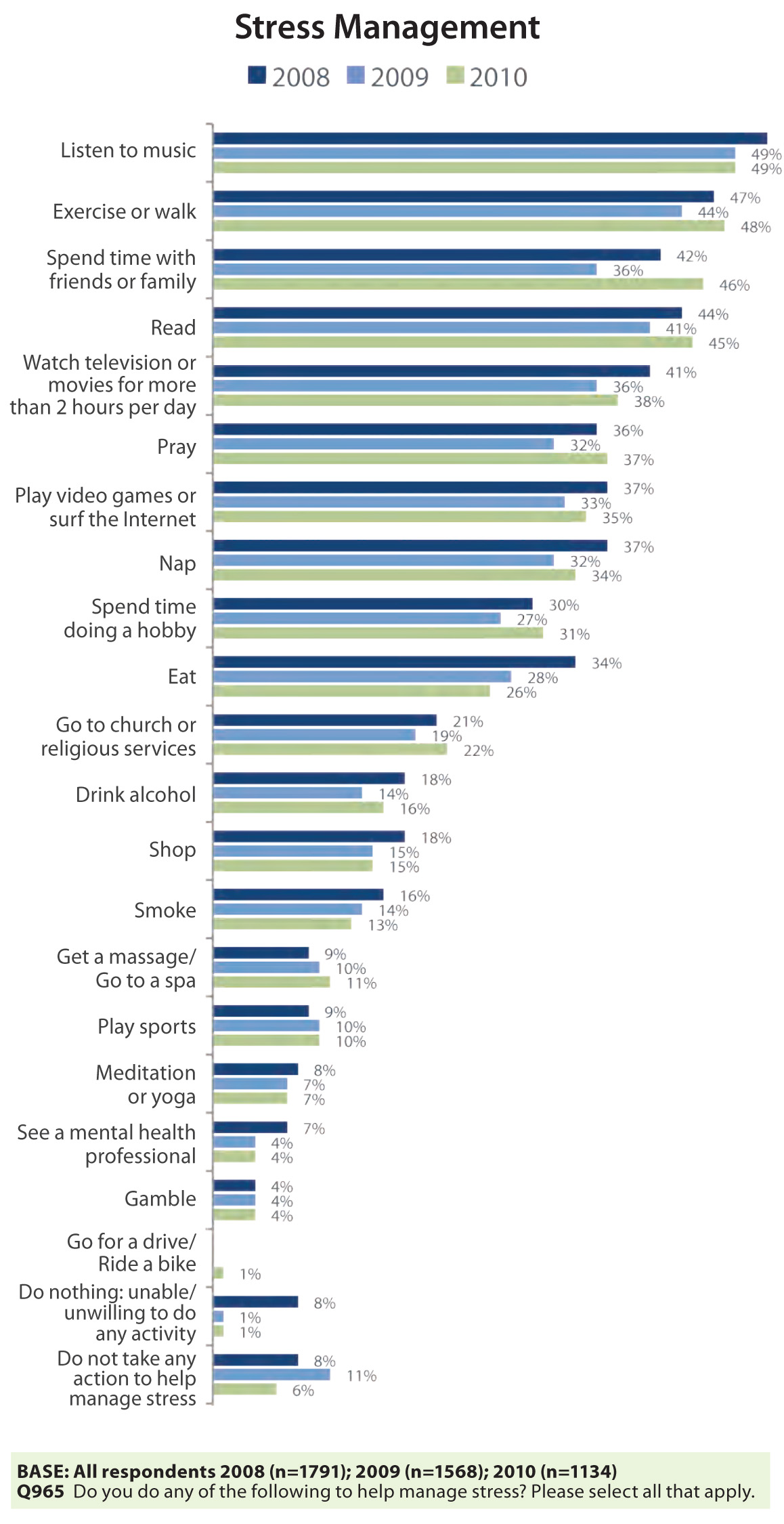
Be patient. Know that you will recover balance and serenity at your own pace. As long as you keep taking steps to move forward, you will eventually reach your destination. Like one-half of survey respondents, you may find that listening to music, exercising, spending time with family or friends and reading are comforting ways to manage stress.

Close to one-half of those surveyed by the American Psychological Association said they experienced irritability and anger as a symptom of stress. The APA has compiled a stress tip sheet to help reduce these kinds of negative emotions. You can learn to manage stress and become more resilient when you practice the strategies we've focused on this week. Nevertheless your emotional recovery, like the Japanese, will take time. Support - both for yourself and what you provide to others - is valuable as you begin the process of rebuilding and restoring hope in these difficult days.

Labels: , , , , , , , , , , ,

Monday, March 21, 2011

Learning How to Cope from the Japanese


For the past 10 days, we've seen heartbreaking pictures of epic devastation in Japan, resulting from the massive earthquake and ravaging tsunami there. And read frightening reports of damaged nuclear reactors with newly elevated levels of radiation in the food and water supply. But what we've also seen are people reacting with composure and a cooperative spirit. And we've read about people demonstrating resilience and unity in the face of tremendous horror. Even with the shock of one-half million homeless and estimates of 10,000 dead, the culture of the Japanese remains one of harmony with a focus on what is best for the group. There is certainly grief and mourning the loss of loved ones, but the reaction to the tragedies has not led to a further deterioration of community cohesion.

From your distance, how do you respond? Are you overwhelmed by the 24-hour news coverage? Has your level of anxiety increased? If you're feeling vulnerable, you're not alone. The emotional reactions to disasters such as these may be even worse for baby boomers, who reveal higher levels of depression than other age groups, according to the website ThirdAge.com.

The palpable distress created by shocking news reports has added to the already high levels of stress identified by the American Psychological Association in their national survey. The study found 75% of the U.S. population experiences at least some stress every two weeks, with half of these rated at moderate or high levels, leaving people emotionally exhausted. And stress levels have increased over the past five years - even before the catastrophes in Japan - impacting both physical and psychological health.

APA has compiled some strategies to help those recovering from disasters. And to reduce your stress levels and take better care of yourself, here are some of our tips to help manage the pressures you face:

Focus on what you can control, not what you can't. The people of Japan could not stop the earthquake or tsunami but they did choose to react to the disasters with teamwork and a sense of purpose. When can't influence negative circumstances of your own, you can still decide how to handle them. Let go of painful thoughts and unrealistic expectations. Keep a journal to aid in the process of releasing frustration and coping with anxiety. Clearly define your goals and aspirations. As you keep your focus on what you can do, a positive accomplishment may emerge from the negative situation. Giving a helping hand does wonders - it provides aide to those in need and makes you feel useful too.

Maintain balance in life between family, job and your own needs. Don't over commit yourself - rather, attempt to retain a normal routine. Set aside some special time for yourself to recover your equilibrium - even if you are a sandwiched boomer with a family in flux. Get enough rest and sleep to allow your body to recover from the stresses of the day. Over 40% of the APA respondents reported lacking energy and feeling fatigued on a regular basis.

Shift your attention to what is truly important. Although hundreds of thousands in Japan lost their homes and possessions, they drew together as families and friends. As you revise your priorities, recognize the value of the underpinnings of your own strength - family, friends, spiritual connection. Express gratitude for your many gifts and change the focus from yourself to those around you. Offer help to those who require it, in Japan or in your own community. You'll feel better when you do and provide essential material support to the needy.

Draw on your strengths. APA survey respondents admitted their lack of willpower to create a healthier lifestyle, but 70% still thought they could improve and make the changes they had identified. What personal strengths have you used in the past to kick-start your progress? Rely on those now as well as ones you've developed more recently. Brainstorm ways to apply these abilities in a novel way.

The recovery in Japan will not be easy or quick. As Confucius said, A journey of 1000 miles begins with a single step. Our hearts are with the people of Japan as they continue to take small steps forward toward personal and national healing. We can all learn from their determined attitude and courageous behavior in reaction to the tremendous crises they face.

For more tips about how you can cope with your own challenges, check back here on Wednesday. And you can receive a complimentary copy of our ebook, Courage and Lessons Learned: Reaching For Your Goals when you sign up for our free monthly newsletter, Stepping Stones.

Labels: , , , , , , , , , ,

Tuesday, March 15, 2011

What Charlie Sheen Can Learn from the Tragic Earthquake in Japan

Often, in the face of disaster, we feel a deep sense of helplessness. And the tragedy in Japan evokes a particular vulnerability when we see the pressing and immediate needs for food and shelter.

Many who have lost everything are offering support and hope to one another - their self reliance and resiliency are apparent. One couple in their late 70s weren't waiting for help. They immediately began fixing up their home so they would be able to help others.

If only Charlie Sheen could access that kind of courage to face up to his problems. Are you dealing with a family situation that requires you to step up to the plate and care for your grandkids? Here are some ideas for you:

Maintain a bond with the ex and extended family. By being civil and keeping the lines of communication open, your grandchildren will transition easier if they have to move from one home and family to the other. And it's impossible for them to have too many loving arms.

There will be a huge void to fill. You may be confused about your role now, so don't be afraid to see a family therapist. Perhaps you were a natural when your kids were little, but this is a unique situation. Learning new techniques from experts can make a big difference the second time around. Talking with someone outside the family about your concerns and frustrations can be a lifesaver.

Do what is necessary to maintain familiarity and continuity.
By nurturing your grandkids and stabilizing their environment, they'll feel more secure. The support and structure you give them will minimize their feelings of anxiety and stress. Children are resilient – they'll thrive as you model positive thinking.

Charlie Sheen lost his kids and his job. And the bitter custody battle with his estranged wife is a heartbreaking tragedy for his children. His wild rants and erratic behavior on streaming webcasts are hard to watch and make you wonder what's coming next. Whether his problems stem from a deep hunger inside, a serious psychological issue or habitual drug use, he needs encouragement to examine his life.

Mental illness and substance abuse are major problems in our society today. Community resources are positioned to help out when our adult children, struggling with these problems, require inpatient treatment rehabilitation.

Through all these difficulties, our grandchildren need representation and someone to speak on their behalf. They deserve role models with strong ethical standards, integrity and character. Just as Charlie Sheen, hopefully, will take care of himself in preparation for return to his family, our children need our support as they get healthy enough to come home and raise our grandchildren.

Labels: , , , , , , , , , , ,

Wednesday, March 02, 2011

How Sandwiched Boomers Can Fight Inertia

This is a continuation of the tips offered on Monday about how to fight inertia. As Sandwiched Boomers with so much on your plate, you may feel overwhelmed and not know where to begin. Take it slow and easy. If some days you can't follow through with your plans, don't let frustration sap your enthusiasm. Think about all those New Year's resolutions you made when you were young and didn't know better. And then remember the inertia that followed the failure of your short-lived goals. Don't fall victim to that kind of logic.

Photo by Filomena Scalise

Make a public commitment to those who want to see you succeed. By telling your family about your intentions, you create a reality that'll keep you feeling motivated. You'll find it may be easier to lose weight by joining a support group or to stop smoking through an organized program.

Lower your expectations. And, for sure, don't expect anything near perfection. Actually, there is no perfection, so relax. Start out small and be OK with baby steps. If Aunt Bess has moved into the nursing home across town, your only choices aren't either to go daily or not at all. Pile the kids in the car one Sunday a month and enjoy an hour in the park with her and your family.

Give up the pleasure principle – that is, having exactly what you want when you want it. Next time you eat out, instead of finishing up with apple pie a la mode, visualize a thinner you in that little black dress at your upcoming high school reunion. Delaying immediate gratification for future goals will lead to feeling better about yourself - and nourish you way beyond your last bite of dessert.

Savor your power. Positive reinforcement is a major part of any behavior modification program, so reward yourself for a job well done. Choose a pleasurable activity that nurtures you, like a trip to the spa or a yoga class. This kind of attitude will sustain you as well as promote greater self care. And as your goals take shape, you'll shape up.

Our website, HerMentorCenter.com, has lots of complimentary articles full of strategies about how to reach your goals. And in this difficult economic climate, our ebook, Taking Care of Stress in a Financial Storm, may be the best $2.45 gift you can give yourself. The information will help you look beyond the present moment. Why not take this chance to get closer to your goals? As you realize that you are making progress, every day will present a new opportunity.

Labels: , , , , , , , ,

Wednesday, January 12, 2011

Optimism about Gabrielle Giffords' and America's Recovery


The recent news has been good concerning the ongoing recovery of Congresswoman Gabrielle Giffords after she was shot point blank in the head on Saturday. Reports are that she is breathing on her own as her husband holds her hand. The outpouring of prayers and good thoughts coming from Americans around the country will help to sustain her and her family through the long and arduous recovery that she faces. Support also goes out to the families of the six murder victims, whose funerals begin tomorrow as 9 year old Christina Taylor Green is laid to rest.

How will the country recover from this tragedy? Will Americans come together to face this heartbreak as one nation or will we be driven apart by finger-pointing and fractious debate? The palpable distress created by the horrific shootings have added to the already high levels of stress identified by the recent national survey conducted by the American Psychological Association.

We hope that such unfathomable horror will never personally touch you or your loved ones, but here are some techniques to use when you are coping with other stresses in your life:

Focus on what you can control and what you can accomplish, not what you can't. Close to one-half of those surveyed by APA said they experienced irritability and anger as a symptom of stress. While you often can't influence circumstances, you can recognize your emotions and control how you handle them. To move away from frustration, let go of negative thoughts and unrealistic expectations. Clearly define your goals or aspirations and keep focused on them. Make something positive come out of a negative situation.

Draw on your strengths. Survey respondents readily admitted their lack of willpower in creating a healthier lifestyle but 70% believe they can improve and institute the changes they have identified. Use the personal strengths you have relied on in the past as well as those you have developed more recently. Brainstorm new ways to apply the abilities you have in a novel way as you generate new opportunities for yourself.

Be patient with yourself. Know that you will recover balance and serenity at your own pace. As long as you keep moving forward, you will eventually reach your destination. Like one-half of survey respondents, you may find that listening to music, exercising, spending time with family or friends and reading are comforting ways to manage your stress.

Talk about your thoughts and feelings with family and friends and reach out to others in your support system. Be open to asking for help and validation of your emotions. You may want to consult a professional counselor for a non-judgmental ear and help in sorting out your concerns. Start a journal to aid in the process of coping with your anxiety.

You'll likely find that your personal recovery, both physical and emotional, will take time. Support is valuable as you begin the process of rebuilding body and spirit and restoring hope as you cope with your own feelings of stress and anxiety. And the American Psychological Association has more tips for coping with stress in the aftermath of traumas such as these horrific shootings.

Labels: , , , , , , , ,